Chile seismic design: where a standard portal frame fails
A portal frame that is fine in a low-seismic market is not a conservative choice in Chile. Drift, gusset clearance, and the base shear that should never travel through an anchor bolt.
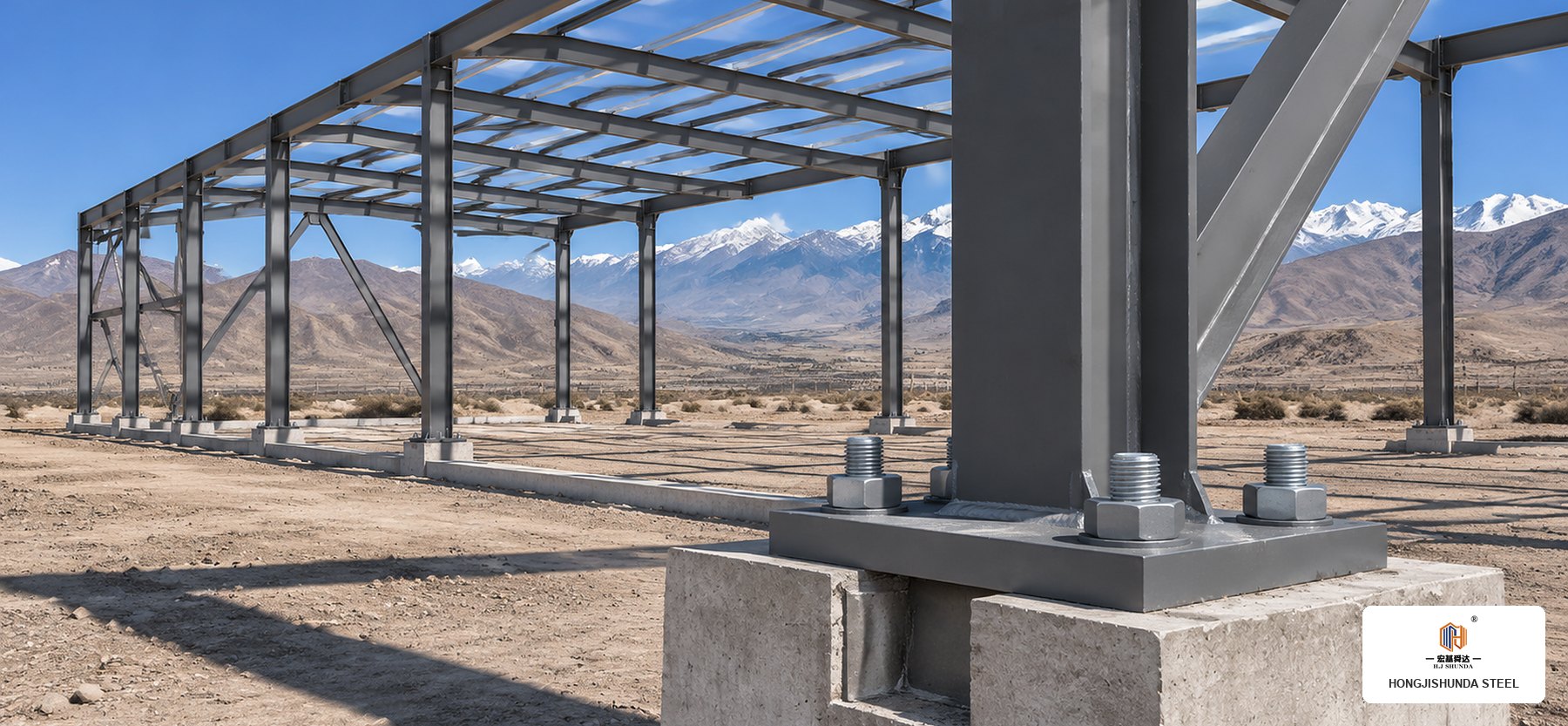
Chile does not forgive lazy engineering.
No other export market tests structural steel with such uncompromising violence. Sitting directly atop the subduction boundary where the Nazca Plate plunges beneath the South American continent, Chile routinely experiences megathrust earthquakes exceeding moment magnitude M_w\ 8.0. What works in West Africa, the Arabian Gulf, or rural Australia will fail in the Central Valley of Santiago or the mining corridors of Antofagasta.
We have reviewed countless tender drawings from international contractors who attempted to export standard, lightweight single-span portal frames directly into Chilean ports.
They sized the rafters for self-weight and a light roof live load. They assumed a generic lateral wind pressure of 0.50 kN/m². They checked member stresses under basic elastic formulas and declared the building optimized.
That is not optimization. It is negligence.
In a Chilean seismic event, an industrial building is not merely subjected to lateral push. It experiences violent multi-directional ground acceleration that tests whether the structure can dissipate enormous kinetic energy through controlled, ductile plastic deformation—or whether it will snap its anchor bolts and shear tabs in brittle fracture.
Here is what decades of international steel fabrication have taught us about getting Chile seismic steel warehouse design right before the containers leave the factory floor.
The Flexible Frame Fallacy: Why Low-Cost Portal Frames Crack
In non-seismic territories, portal frame design aims to make members as light and flexible as possible. A flexible frame absorbs wind gusts through elastic deflection. It sways, sheds wind energy, and rebounds.
In Chile, excessive flexibility is catastrophic.
Under the code that governs industrial facilities in Chile, lateral drift is strictly limited. Why? Because industrial warehouses house heavy processing machinery, elevated overhead crane girders, automated pallet racking, and rigid utility piping.
If a 10-meter-high eaves column deflects 150 mm laterally (a 1.5% drift typical of cheap commercial sheds), three things happen within fifteen seconds:
- The overhead crane rails misalign instantly, binding crane trolley wheels and bending crane brackets under dynamic lateral thrust.
- Rigid exterior insulated sandwich panels buckle and pop their fasteners, raining heavy metal sheets into the yard.
- Rigid water, slurry, or gas pipes connected to the frame shear off, creating secondary industrial disaster risks.
Chilean practice holds drift to a small fraction of building height — far below the one and a half percent a cheap commercial shed drifts. Ask for the limit that applies to your site, in writing. To achieve that stiffness without inflating steel tonnage to unviable levels, you cannot rely on bare moment frames alone. You must introduce stiff, ductile lateral force-resisting systems.
```
Flexible Unbraced Portal (1.5% Drift) --------> Crane Derailment & Joint Fracture
Ductile Concentric Braced Frame (0.35% Drift) --> Stiff, Elastic Envelope Survives
```
The Three Detailing Rules You Cannot Ignore
When our design team translates Chilean client specifications into structural fabrication models, we focus our detailing on three critical areas where standard export designs fail.
1. Concentric Bracing and the 2t Gusset Clearance Rule
In seismic zones, bracing members must serve as structural fuses. Under intense ground shaking, diagonal braces cycle between heavy tension and compression buckling.
If a diagonal tube brace is welded rigidly to a gusset plate right up against the column-beam corner, the gusset cannot bend. Instead, the weld tears, or the brace shears cleanly at the net bolt area.
Under the detailing rules that govern ductile braced frames, the gusset plate must provide an unconstrained folding line—a clear zone perpendicular to the brace axis equal to at least two times the gusset thickness (2t). This allows the gusset plate to yield and form a ductile plastic hinge when the brace buckles out of plane, absorbing earthquake energy without tearing the primary frame connection apart.
2. Eliminating Shear on Anchor Bolts
A fundamental rule on our South American projects: anchor bolts are designed to resist uplift tension, never seismic base shear.
During a Chilean earthquake on the coast, where ground acceleration is highest, horizontal base shear can approach a quarter to a third of the total dead load of the structure. If you expect four 24 mm anchor bolts to transfer that massive shear into concrete footings through bearing, the bolts will bend, concrete edges will spall, and the column base will walk across the pedestal.
We always weld a heavy structural shear key (shear lug)—typically a stub of heavy universal beam or wide-flange section—beneath the center of the baseplate. The shear key drops into a pre-formed pocket in the concrete foundation, transferring 100% of the horizontal seismic thrust directly into the foundation core. The anchor bolts remain free to handle pure axial tension.
3. Strong-Column, Weak-Beam Plastic Detailing
If an earthquake forces plastic hinges to form in the building skeleton, those hinges must develop in the roof rafters, never in the columns. A hinging beam causes roof sagging; a hinging column causes total progressive building collapse.
We ensure column sections possess a plastic flexural capacity significantly greater than the framing rafters, and we reinforce column webs with continuity plates (transverse stiffeners) aligned precisely with the rafter flanges to prevent web crippling under cyclic bending reversals.
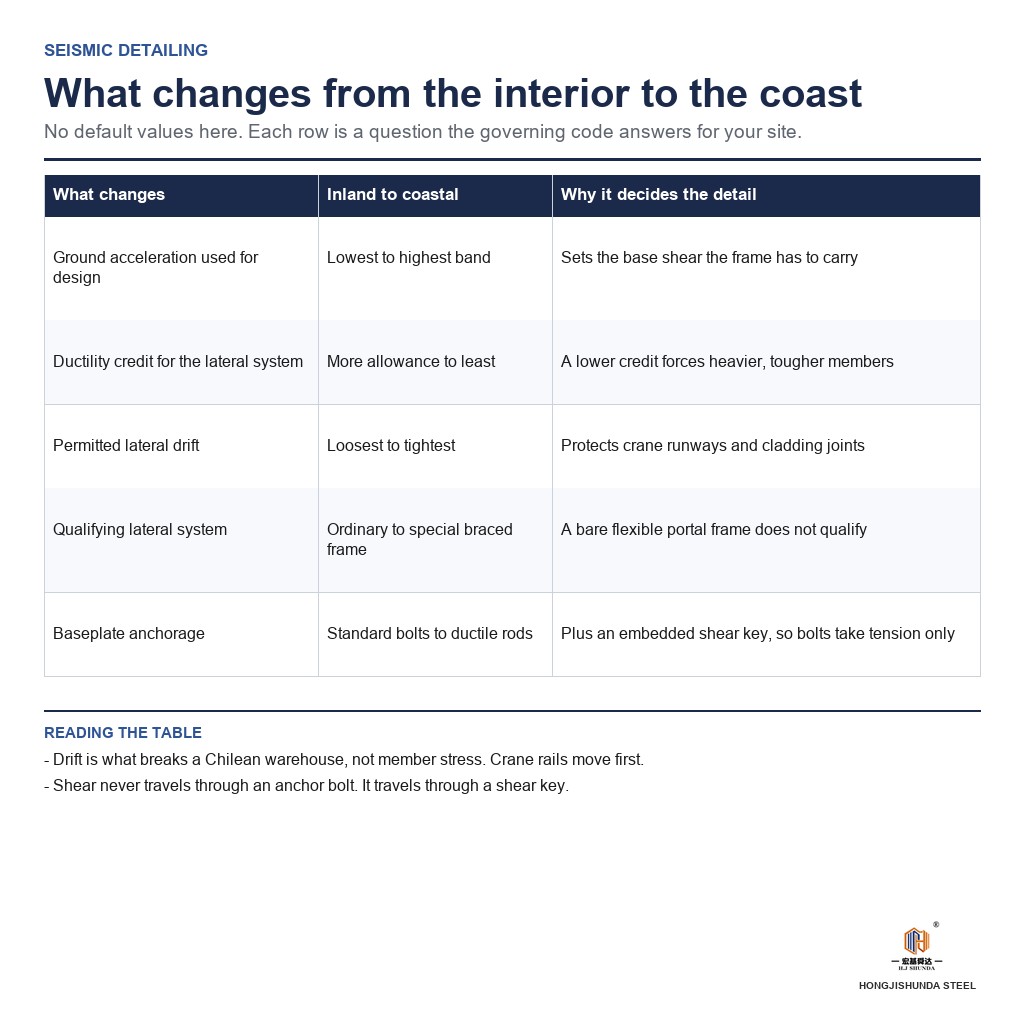
Chile Seismic Engineering Matrix by Zone
Chile is divided into three primary seismic exposure zones, spanning from the Andes mountain pre-cordillera to the deep-water Pacific shelf:
| What changes | Inland / pre-cordillera | Central valley | Coastal, high subduction | Why it decides the detailing |
|---|---|---|---|---|
| Ground acceleration used for design | Lowest band | Intermediate band | Highest band | Sets the base shear the frame has to carry |
| Ductility credit given to the lateral system | More elastic allowance | Reduced | Least allowance | A lower credit forces heavier, tougher members |
| Permitted lateral drift | Loosest limit | Tighter | Tightest | Protects crane runways and cladding joints |
| Lateral system that qualifies | Ordinary braced frame | Concentric braced frame | Special concentric braced frame | A bare flexible portal frame does not qualify at all |
| Baseplate anchorage | Standard cast-in bolts | Extended unbonded stretch length | Ductile rods plus an embedded shear key | Prevents brittle concrete pull-out |
The Commercial Balance: Complying Without Overpaying
Many international developers believe that designing for Chilean seismicity means doubling the building's structural tonnage. That is a myth born of blunt-force engineering.
Smart seismic engineering does not add steel everywhere. It places stiffness where it belongs.
By using high-strength structural steel with impact toughness tested at low temperature (so the steel stays ductile in a cold winter), incorporating calibrated hollow section (HSS) vertical bracing bays, and utilizing shear lugs at the foundations, we routinely deliver fully compliant Chilean industrial structures that add only 8% to 12% to overall structural weight compared to standard low-seismic buildings.
We provide full 3D Tekla structural models and engineering calculation sheets verified against local Chilean requirements, ensuring smooth municipal permitting with local municipal directors (Dirección de Obras Municipales).
If you are developing a mining warehouse in Antofagasta, an agro-industrial processing plant in Rancagua, or a logistics terminal near San Antonio or Valparaíso, consult our South American engineering desk or connect directly via WhatsApp +86 133 6387 9800 for an initial structural review.
To examine our heavy industrial pre-engineered steel buildings, visit our corporate portal at hongjishunda.com or explore our industrial warehouse product configurations.
Where to read next
Send the site conditions and we will answer with the numbers that matter