Hot-dip galvanizing or paint: what actually decides it
Galvanizing and paint fail in different ways, on different parts of the same building. How to split one structure into zones and specify each one once.
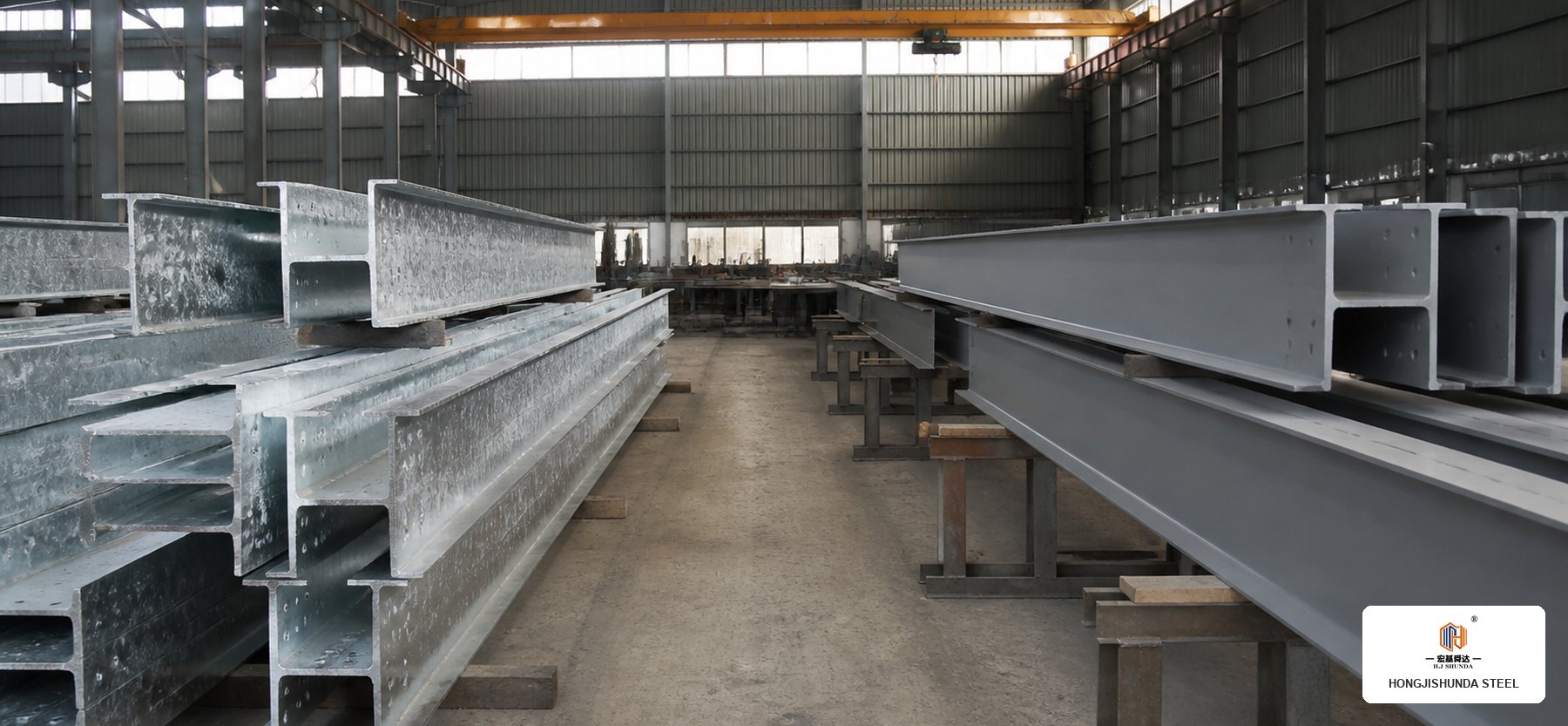
Every buyer eventually asks this question. Usually it comes after a side-by-side comparison shows the galvanized option carrying the higher initial figure — and a wish to know whether that premium is justified.
The short answer: it depends on where your building is, what it stores, and how long you need it to last. The longer answer requires understanding what each system actually does.
What Paint Does — and Where It Fails
A paint system for structural steel works by creating a barrier between the steel surface and the corrosive environment. A well-specified system for a moderately corrosive environment will include a primer coat (often zinc-rich epoxy or red oxide), one or two intermediate coats, and a topcoat with UV and abrasion resistance. Total dry film thickness (DFT) for a moderately corrosive inland environment is typically 160 to 240 microns (6.3 to 9.4 mils) across the complete system.
Paint works well when it remains intact. The problem is that paint is a surface coating. It sits on top of the steel. Any mechanical damage — abrasion, impact, cutting, drilling, weld splatter — breaks the barrier and exposes bare metal. Once bare metal is exposed in a humid environment, oxidation begins at that point and progresses laterally under the surrounding paint film in a process called undercutting. What looks like a small scratch on the surface is often a larger zone of sub-surface corrosion by the time it becomes visible.
The other failure mode is surface preparation quality at the factory. Paint adhesion depends critically on the cleanliness and profile of the steel surface before painting. Near-white blast cleaning — which removes mill scale, rust and contamination — produces the surface profile that paint systems are designed for. Weaker preparation, particularly power-tool grinding without blasting, produces a significantly shorter service life regardless of paint quality, because the underlying surface is not correct.
In our experience, surface preparation is the most common factor in early paint failure on export projects. A supplier with proper blasting equipment and quality control will produce a durable coating. A supplier who substitutes mechanical cleaning for blast cleaning to reduce production cost will not.
What Hot-Dip Galvanizing Does
Hot-dip galvanizing (HDG) works differently. The steel member is cleaned, fluxed, and immersed in a bath of molten zinc at approximately 450°C (about 840°F). The zinc reacts metallurgically with the iron in the steel to form a series of zinc-iron alloy layers, topped by an outer layer of pure zinc. The coating is not a surface film — it is bonded to the steel at the molecular level.
The typical HDG coating thickness on structural steel sections is 45 to 85 microns (1.8 to 3.3 mils), which is thinner than a paint system. But because the zinc is metallurgically bonded rather than mechanically adhered, it protects by a different mechanism. Even where the coating is physically damaged, the surrounding zinc provides cathodic protection — the zinc corrodes preferentially, sacrificing itself to protect the exposed steel. A painted coating does not do this.
The practical consequences:
- HDG is dramatically more tolerant of site damage. Bolt holes, cut ends, weld areas and handling damage on a galvanized member present far less long-term corrosion risk than the same damage on a painted member.
- HDG requires no maintenance for the first 20 to 40 years in most environments (the specific life depends on how corrosive the site environment is).
- HDG is not easily recoated or touched up in the field. If a galvanized section needs repair, zinc-rich cold-spray compounds are used, but they do not replicate the metallurgical bond of the original coating.
How to Choose for Your Project
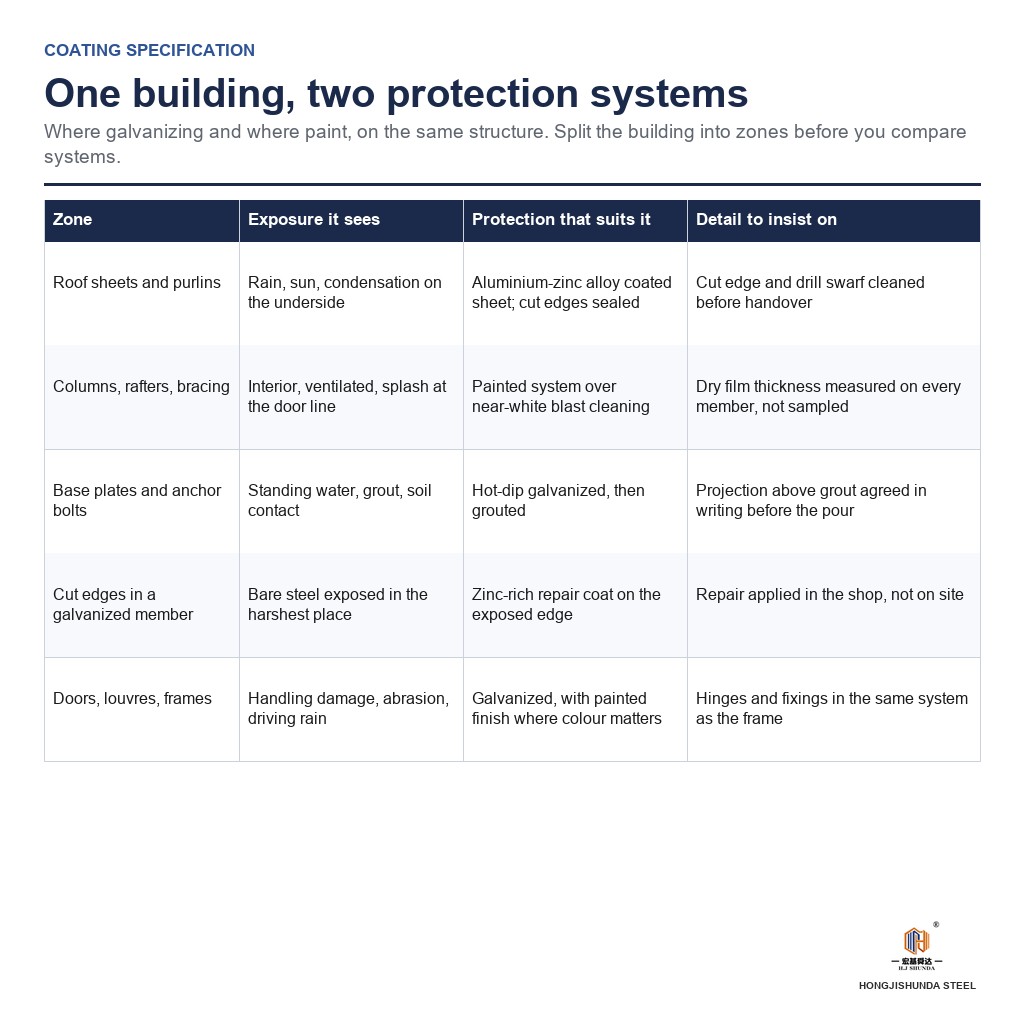
The decision is not binary, and specifying everything as galvanized or everything as painted is rarely the right answer. Most well-designed buildings use a combination.
| Component | Recommended Protection | Reason |
|---|---|---|
| Primary structural members (columns, rafters) | High-build paint — zinc-rich primer + epoxy + PU topcoat, near-white blast preparation | Members are large, handled carefully, protected by cladding; dry film thickness 200–280 µm (7.9–11.0 mils) on highly corrosive coastal sites |
| Secondary purlins and girts | Hot-dip galvanized | High surface area, site-cut frequently, abrasion-prone during installation |
| Bolts, nuts, washers | Hot-dip galvanized or mechanical zinc plating | Small parts, high surface-to-volume ratio, critical fastening function |
| Anchor bolts (below-grade or grout-encased) | Hot-dip galvanized | Partially inaccessible after construction; repair extremely difficult |
| Roof and wall cladding | Aluminium-zinc alloy coated steel, or HDG with colour coat | Thin gauge material — paint-only on thin sheet has a limited life in highly corrosive coastal environments |
| Crane beams and runway rails | Paint — heavy-build epoxy, with inspection protocol | HDG is not typically available in the required sections; regular inspection compensates |
For projects in coastal zones — within roughly 1 to 3 kilometres (0.6 to 1.9 miles) of open sea in a tropical climate — the environment is severely corrosive. In the most aggressive coastal exposure, conventional paint systems degrade at roughly double the rate of a moderately corrosive inland site. The combination specification above, applied with near-white blast preparation and correct dry film thickness verification, is the minimum we would recommend for a building expected to perform for 20 years without major remediation.
For projects inland in sub-Saharan Africa or interior South America, a mildly to moderately corrosive environment is more typical. A good-quality three-coat paint system with a zinc-rich primer, applied to a properly prepared surface, will deliver 15 to 20 years of service with annual inspection and minor spot repairs.
The Question to Ask Your Supplier
Two things to verify before accepting the corrosion protection specification:
"What surface preparation is used before painting, and how is it verified?"
The answer should be near-white blast cleaning, verified by visual comparison against reference photographs of correctly prepared surfaces or by a surface profile gauge measurement. If the answer is "we grind the surface before painting" without blasting, the service life of the coating will be substantially shorter than the specification suggests.
"What is the dry film thickness of the complete paint system, and is it measured per coat or at final completion?"
Dry film thickness should be measured per coat and at final completion, using a certified gauge. The coating specification should state the minimum and maximum dry film thickness for each coat and the total system. A supplier who cannot specify thickness by coat, or does not measure it during production, is not controlling the output they are quoting you.
For buildings in harsh corrosive environments — coastal Africa, coastal South America, industrial sites with chemical exposure — the difference between a correctly specified and incorrectly executed corrosion protection system is measured in years of building life, and in remediation cost that can run to a large multiple of the original protection spend. It is worth asking.
Where to read next
Send the site conditions and we will answer with the numbers that matter