Coastal salt spray: what eighteen months actually does to a steel building
Salt spray does not announce itself. It takes the fasteners first, then the cut edges, then the lapped joints. What to specify, and the four questions that expose a standard package.
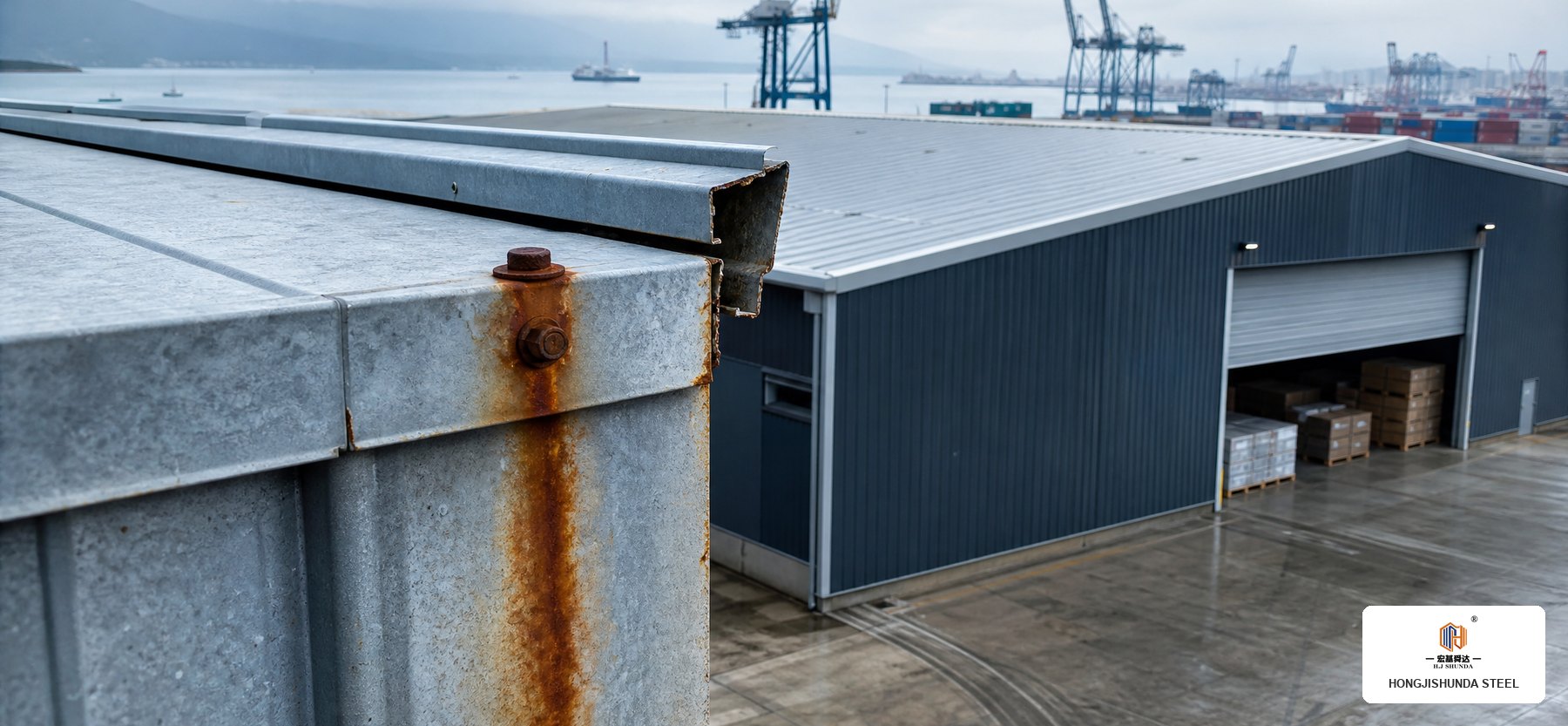
Eighteen months.
That is roughly how long a standard painted steel building — specified for a temperate inland site — will last before showing visible corrosion at fastener positions when it is placed within 1 kilometre of the South American Pacific or Atlantic coast. We have seen this pattern in northern Chile, in the Buenos Aires industrial belt, and on Brazil's coastal industrial zones from Paranaguá to Santos. The building looks fine from the outside. Walk up close and count the rust streaks running from every self-tapping screw on the roof. They are already there.
Coastal salt spray corrosion is not a dramatic event. It is a slow, continuous chemical process driven by chloride ions deposited from sea air. It does not announce itself. It accumulates.
And it is entirely manageable — if it is specified correctly at the design stage.
What Salt Spray Actually Does to Steel
Standard structural steel is not inherently resistant to chloride attack. The protective oxide layer that forms naturally on carbon steel in clean inland air does not form reliably in a salt-laden environment. Instead, chloride ions penetrate any break or pinhole in the coating, initiate corrosion at the steel surface underneath, and then accelerate it by creating a localised electrochemical cell. The rust that forms is expansive — it occupies more volume than the steel it replaces — and this expansion progressively lifts the coating from the steel surface, creating blisters that you can feel before you can see them.
The process is fastest at:
- Fastener penetrations — every self-tapping screw or bolt creates a micro-gap between the coating and the steel at the point of contact
- Cut edges — roof and wall sheet edges cut during fabrication or on site, where the zinc layer (if any) and paint are both absent
- Lapped joints — the capillary space between overlapping sheets traps salt water and holds it against the steel surface
- Welds — the heat-affected zone around a weld changes the steel microstructure and can create preferential corrosion sites if not recoated properly
This is not speculation. It is the documented failure sequence for carbon steel in the two highest exposure bands — the conditions that apply to most coastal industrial sites in Chile, Argentina, and Brazil.
How Close Is Too Close?
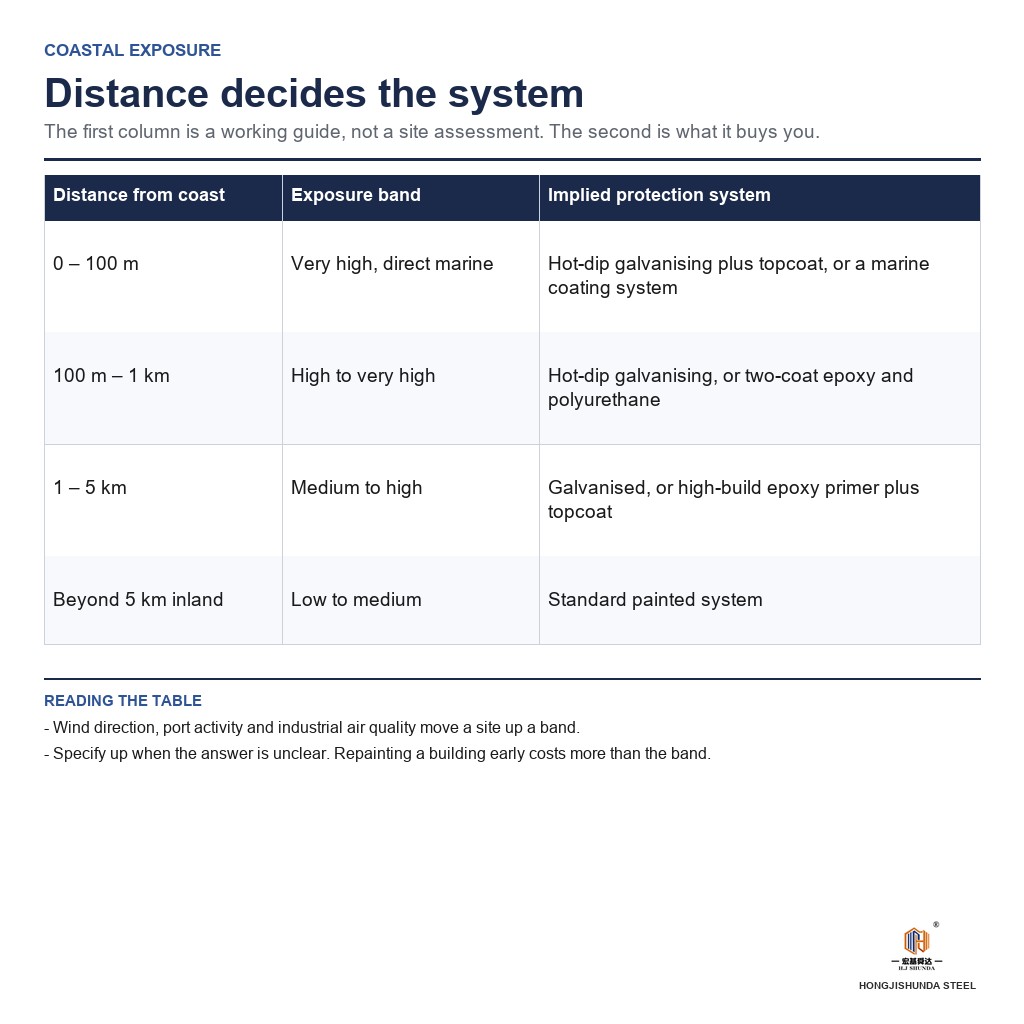
The relationship between distance from the coast and corrosion rate is not linear — it drops sharply with distance. As a working guide:
| Distance from coast | Exposure band (typical) | Implied protection system |
|---|---|---|
| 0–100 m | Very high, direct marine | Hot-dip galvanising + top coat, or specialised marine coating system |
| 100 m–1 km | High to very high | Hot-dip galvanising, or two-coat epoxy + polyurethane topcoat, ≥ 160 µm DFT |
| 1–5 km | Medium to high | Galvanised or high-build epoxy primer + topcoat, ≥ 120 µm DFT |
| > 5 km inland | Low to medium | Standard painted system, ≥ 80 µm DFT |
The distances above are rough guides. Local wind direction, prevailing onshore/offshore patterns, industrial air quality, and site elevation all affect the actual deposition rate. In our experience on coastal South American projects, buyers frequently underestimate how severe their site actually is — particularly for sites in industrial port zones where the combination of salt air and chemical contamination pushes the site into the top band.
When in doubt, specify up. The cost difference between a medium-band and a top-band coating system is modest relative to the cost of repainting a building three years early — or replacing corroded structural members.
What to Specify for Coastal South America
The structural steel itself does not change. The specification that changes is the corrosion protection system applied to it.
For primary structural members (columns, rafters, purlins):
Hot-dip galvanising followed by a two-coat paint system — an epoxy primer and a polyurethane or fluoropolymer topcoat — is the most durable option in the two highest bands. The galvanising provides sacrificial zinc protection at any coating damage point; the topcoat provides the barrier against chloride ingress.
We would not specify a single-coat paint system alone on any structural member for a site within 3 kilometres of the coast in coastal Chile or Brazil. We have seen the results. It is not adequate.
For roof and wall sheeting:
Hot-dip galvanised or Galvalume (aluminium-zinc alloy coated) steel sheet is significantly more resistant to coastal corrosion than standard galvanised sheet. The aluminium-zinc coating provides both barrier and sacrificial protection, and performs substantially better in high-chloride environments.
For fasteners:
Stainless steel fasteners, austenitic grade rather than zinc-plated, at all roof and wall sheet connections in the two highest bands. Standard zinc-plated carbon steel screws will fail at the shank before the surrounding sheet shows visible corrosion — and a failed fastener is a roof leak, not just a cosmetic problem.
For sealants and closures:
Silicone or modified silicone sealant at all lapped joints and penetrations. Butyl foam closures at ridge and eave must be sealed additionally, not relied on alone. The foam compresses and cracks within a few years in UV-exposed coastal conditions.
The Conversation You Should Have Before Signing
Ask your supplier these questions for any coastal South America project:
Q: Which exposure band have you designed for, and on what basis?
If the answer is a band label with no site assessment behind it, ask how they arrived at it. "Coastal" is not a specification.
Q: What is the total dry film thickness of the coating system on structural members?
If it is below 120 µm for a coastal site, ask why.
Q: Are the fasteners stainless steel or zinc-plated?
The default in most standard supply is zinc-plated. For coastal sites, request stainless steel as a standard — not an upgrade.
Q: Is the sheeting Galvalume or standard galvanised?
Again, standard supply in most markets is standard galvanised. Galvalume or equivalent aluminium-zinc alloy products are typically available for a modest premium and are worth specifying for any site in the two highest bands.
A supplier who cannot answer these questions specifically is not designing for your site conditions. They are providing a standard product and assuming the environment is not harsh.
Coastal South America is harsh.
If you are planning a warehouse, workshop, or processing facility at a coastal site in Brazil, Chile, Argentina, or elsewhere in South America, we can review the proposed specification against the exposure band your site actually falls in before the design is finalised. Reach our technical team at johnnysteelco.com or hongjishunda.com, or contact Johnny Joe directly on WhatsApp / WeChat at +86 133 6387 9800. Getting the corrosion protection right at the specification stage costs a fraction of what remediation costs later.
Exposure bands and coating guidance in this article are general principles, not a site assessment. Site-specific conditions require assessment by a qualified corrosion or structural engineer. Actual corrosion rates depend on local climate data, industrial contamination, and site-specific factors.
Where to read next
Send the site conditions and we will answer with the numbers that matter