Q235, Q345, Q355: which steel grade actually matters
The three grades differ by less than most buyers think, and far more than most salespeople admit. What the numbers mean, and the four documents that prove them.
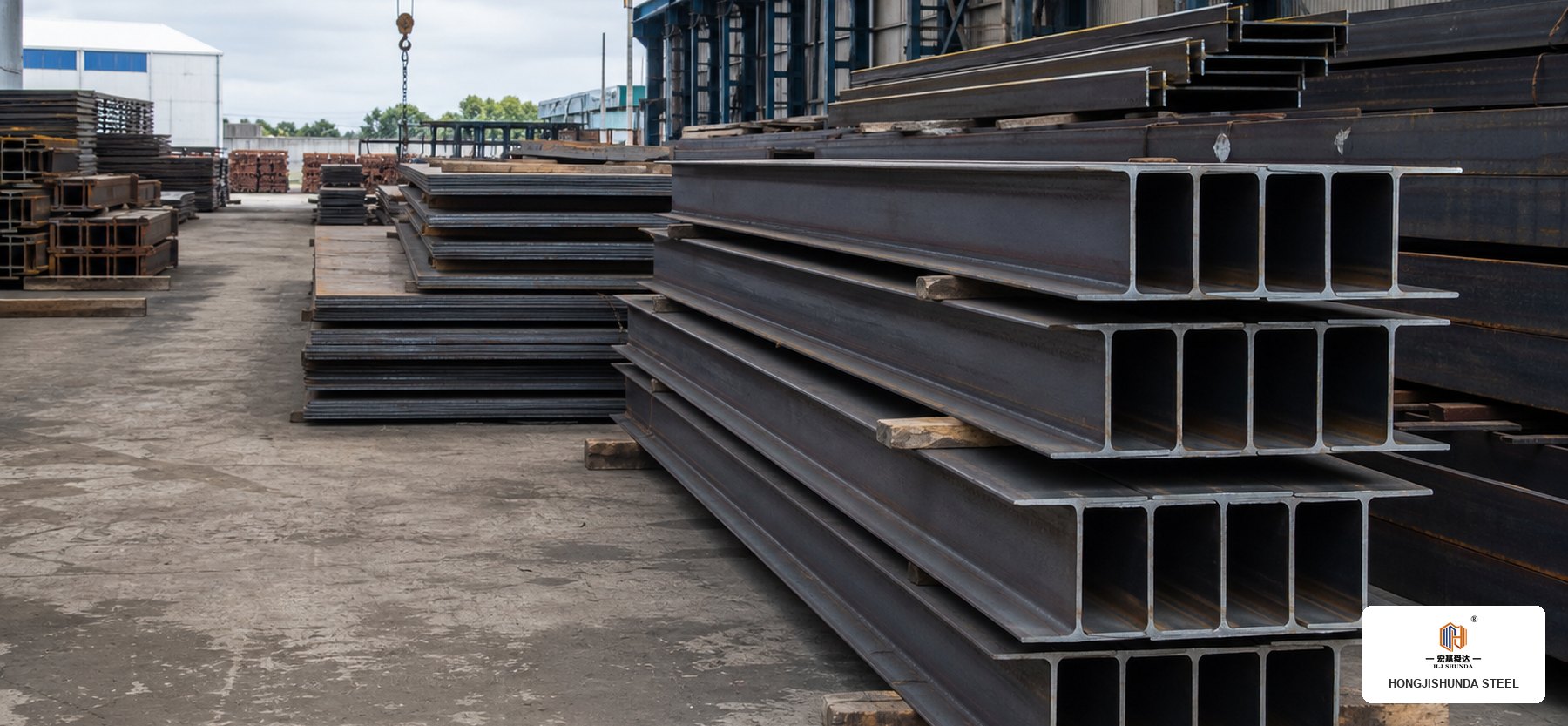
The phone call nobody wants to receive: your contractor just told you the steel arrived on site and the cross-sections look thinner than expected. You pull out the drawings. The spec says Q345. The mill certificate says Q235. Somewhere between the factory floor in Hebei and a port warehouse in Mozambique, somebody made a substitution — and now the whole erection schedule is in question.
This happens. Not often, but often enough that we check mill certificates against physical heat numbers on every shipment.
So let's talk about steel grades, because they matter far more than most buyers realise — and far less than some salespeople will tell you.
The Short Version: What These Numbers Actually Mean
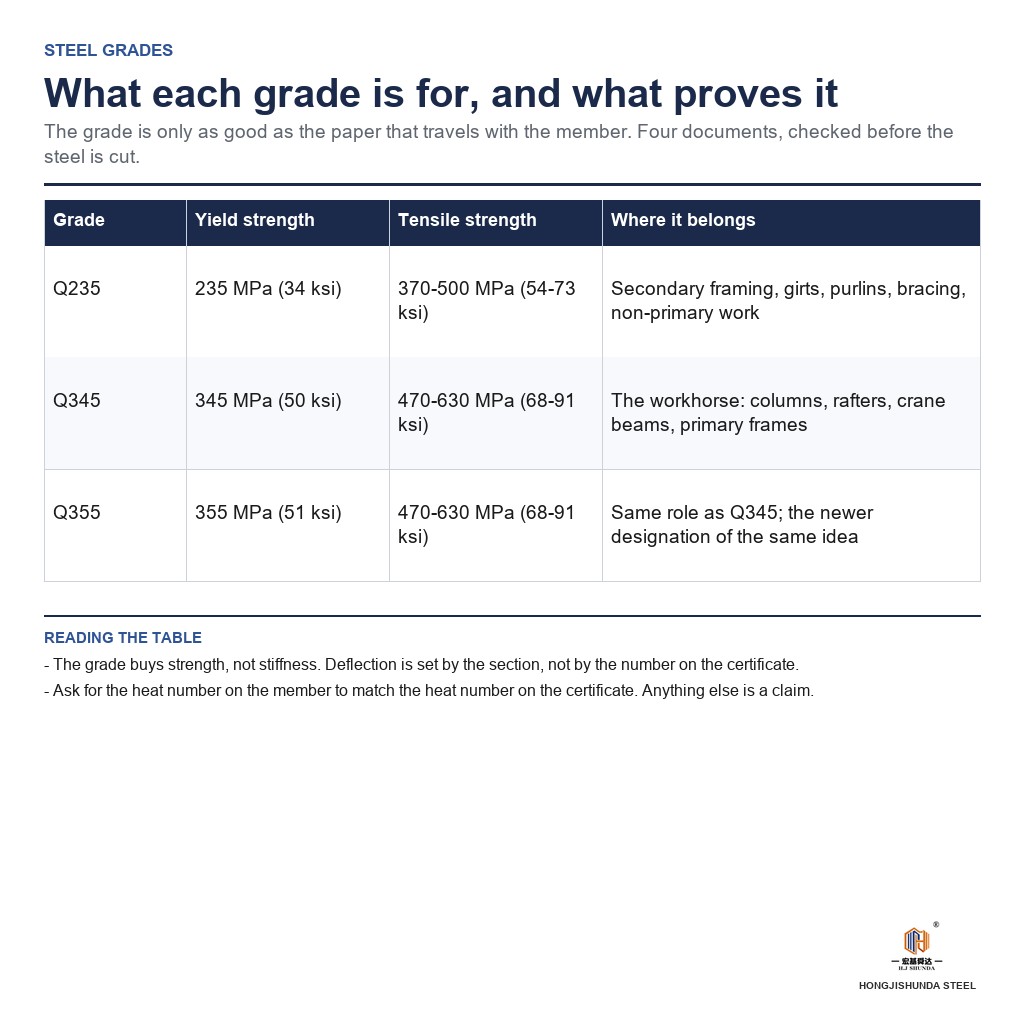
Q235, Q345, and Q355 are Chinese national standard structural steel designations. The "Q" stands for qu fu dian — yield strength. The number is the minimum yield strength in megapascals (MPa) for plate thickness up to 16 mm.
| Grade | Min. Yield Strength | Tensile Strength | Common Applications |
|---|---|---|---|
| Q235 | 235 MPa | 370–500 MPa | Purlins, girts, secondary framing, bracing rods |
| Q345 | 345 MPa | 470–630 MPa | Primary frames (columns, rafters), crane beams |
| Q355 | 355 MPa | 470–630 MPa | Same as Q345; newer revision of the same designation |
Q355 replaced Q345 as the standard designation when China updated that standard in 2018. Mechanically they are nearly identical — if a supplier quotes Q345 today, they should be supplying Q355 steel. Same yield, same application logic. The naming just changed.
Where Grade Confusion Creates Real Problems
In a simple small-span portal frame — say, a 15 m × 50 m single-storey warehouse with no overhead crane and light roof loads — Q235 columns and rafters may be structurally adequate. The engineer will compensate with slightly larger cross-sections. Under normal conditions, the building stands fine.
But add three things, and that calculation changes fast:
1. Crane loads. Any building with an overhead crane carrying more than 5 tonnes needs Q345/Q355 primary frames. Fatigue loading from repeated crane cycles is particularly hard on lower-strength steel. We would never spec Q235 for a crane beam. Full stop.
2. Wind exposure. Port-side buildings in coastal Mozambique or southern Brazil regularly see sustained wind speeds that push design pressures well above 0.5 kN/m². Higher strength steel lets the engineer achieve adequate sections without excessive weight — and weight matters when you're paying ocean freight by the tonne.
3. Span. Above roughly 24 m clear span, using Q235 for primary frames means noticeably heavier steel sections to meet deflection limits. The tonne-cost difference disappears. What doesn't disappear is the higher freight cost.
The practical rule: use Q235 for secondary structure (purlins, girts, bracing), Q355 for primary frames in any meaningful building.
What to Check on the Mill Certificate
A mill certificate (sometimes called a MTR — material test report) should accompany every shipment. It is not a formality. Here is what to look for:
- Heat number matches the marking on the steel sections
- Chemical composition is within the standard tolerance (particularly carbon content — above 0.22% for Q235 starts causing weldability issues)
- Mechanical properties: yield strength, tensile strength, and elongation are all reported
- Charpy impact test results — critical if your project site has cold winters (less relevant in tropical Africa, but still worth checking)
A certificate that lists only the grade name and no actual test values is a red flag. Push back.
Hot-Dip Galvanising vs. Paint: The Corrosion Decision
Grade selection is only half the durability equation. The other half is surface protection — and this is where we see the most budget-driven shortcuts.
Standard two-coat painting (primer plus finish coat, total dry film thickness around 80–100 microns) is adequate for dry inland environments with proper maintenance. On our Mozambique projects near the coastline, we specify hot-dip galvanising for all secondary steel and at minimum an epoxy-based coating system totalling 180–200 microns DFT for primary frames. Coastal salt air degrades standard paint systems faster than anyone budgets for.
The cost difference between a basic paint system and a proper HDG or epoxy-polyurethane system is real — a real premium on the steel package. But compare that to the cost of repainting an entire structure in year 8 because the original coat failed, and the math changes.
A few specifics:
- Hot-dip galvanised (or an equivalent coating standard): zinc coating 85 µm (3.3 mils) minimum for steel above 6 mm. Excellent for purlins, girts, secondary connections exposed to moisture.
- Epoxy primer + polyurethane topcoat: suitable for primary frames where full immersion galvanising is impractical (large columns, heavy rafters). Near-white blast cleaning before coating is non-negotiable — coating over mill scale fails.
- Paint only, no blast cleaning: we see this on cheap packages. Surface prep accounts for 60–70% of coating performance. If the factory is brush-cleaning and hand-painting, the coating is decorative, not protective.
Ask your supplier specifically: what is the surface preparation standard, and what is the total dry film thickness on primary steel? If they can't answer in seconds, that tells you something.
Weld Quality: The Invisible Factor
Steel grade and coating are both visible. Weld quality is not — and that's why it matters.
Primary frame connections in a portal frame are typically welded in the factory (shop fabrication) and bolted on site. Shop welds should comply with GB 50661 or equivalent. For buildings with crane beams or seismic requirements, full penetration welds at critical joints are standard.
What to ask for: a welding procedure qualification record (WPQR) and confirmation that welders are certified. On large export orders, third-party inspection before shipment is worth the cost. A visual inspection at the point of manufacture, not at the destination port, is when problems are still fixable.
A Practical Summary
Before you approve a steel package, confirm these four things:
- Grade: Primary frames in Q355 (or Q345 — same steel, old name). Secondary structure in Q235 is acceptable.
- Certificates: Mill certificates with actual test data, heat numbers traceable to the steel.
- Coating system: Specify DFT in writing, specify surface prep standard. "Painted" is not a specification.
- Weld inspection: For any building with cranes or unusual loads, third-party weld inspection before shipping.
None of this is complicated. It just requires asking the right questions before the container is sealed — not after it arrives on site.
Where to read next
Send the site conditions and we will answer with the numbers that matter