High-strength bolts ship in bulk, not in kits
Bolts travel as one bulk pack counted from the bill of quantities, not as a bag per connection. Where the count comes from, what is written on the pack, and what goes wrong when it is split.
The short answer: one bulk pack, not one bag per connection
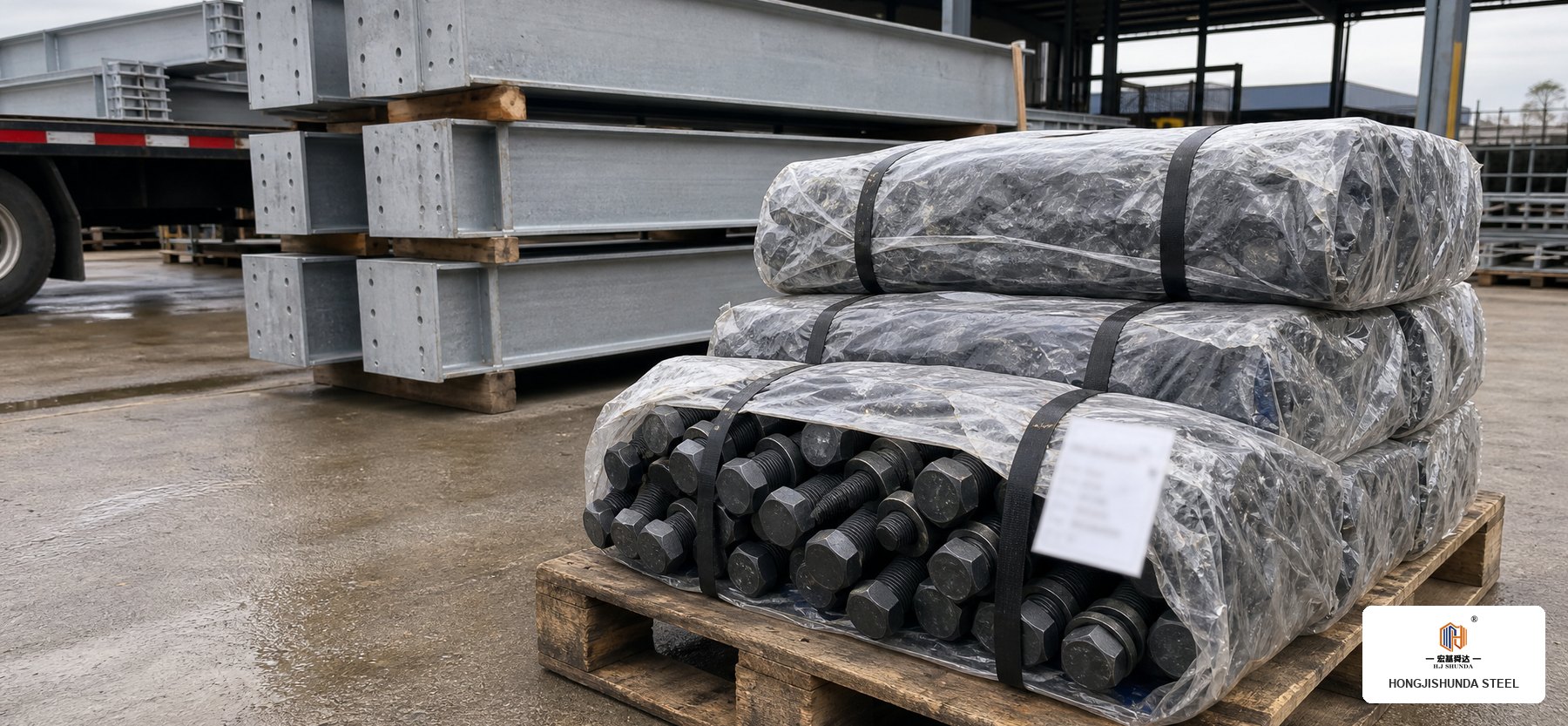
On a steel building shipment, the high-strength bolts do not travel as hundreds of small bags, one per connection, each labelled to the member it belongs to. They travel as a bulk pack: counted once from the bill of quantities, packed by diameter and property class, and shipped in the same consignment as the members they will join.
That is how we do it. The bolts are packed in bulk rather than split into per-member kits, the quantity is taken from the bill of quantities for the building, and the bolts are quoted and delivered together with the building rather than as a separate item on a separate delivery.
The reasoning is practical rather than theoretical. A kitted shipment looks tidy in the packing hall and becomes fragile everywhere after it. A bulk pack looks crude and holds together.
Why the bolts do not travel boxed with their members
Bolts are consumed by the connection, not by the member. A rafter may carry a dozen connections, each with a different bolt count; a column may carry four. If you pack per member, you are guessing at the erection sequence before erection has been planned, and you are creating one small package for every guess.
Every small package is a unit that can be miscounted, mislaid, crushed, or opened at customs and not resealed. On a shipment with several hundred members, per-member kitting turns one countable item into several hundred uncountable ones. The packing list becomes a document nobody can check in an afternoon at the port.
What bulk means in practice on a steel shipment
In practice, bulk means the bolts for one building, or for one shipping phase of one building, arrive as a small number of packs. Each pack is uniform: one diameter, one length, one property class, a stated quantity, and a label that ties it to the project and the phase.
The pack is heavy and awkward, and that is the point. A heavy pack does not disappear behind a container door. It is counted once, signed for once, and stored once. Nothing in it needs to be identified against a drawing before it can be used, because the identification is on the outside of the pack, not on four hundred little bags inside it.
How the count is fixed before fabrication
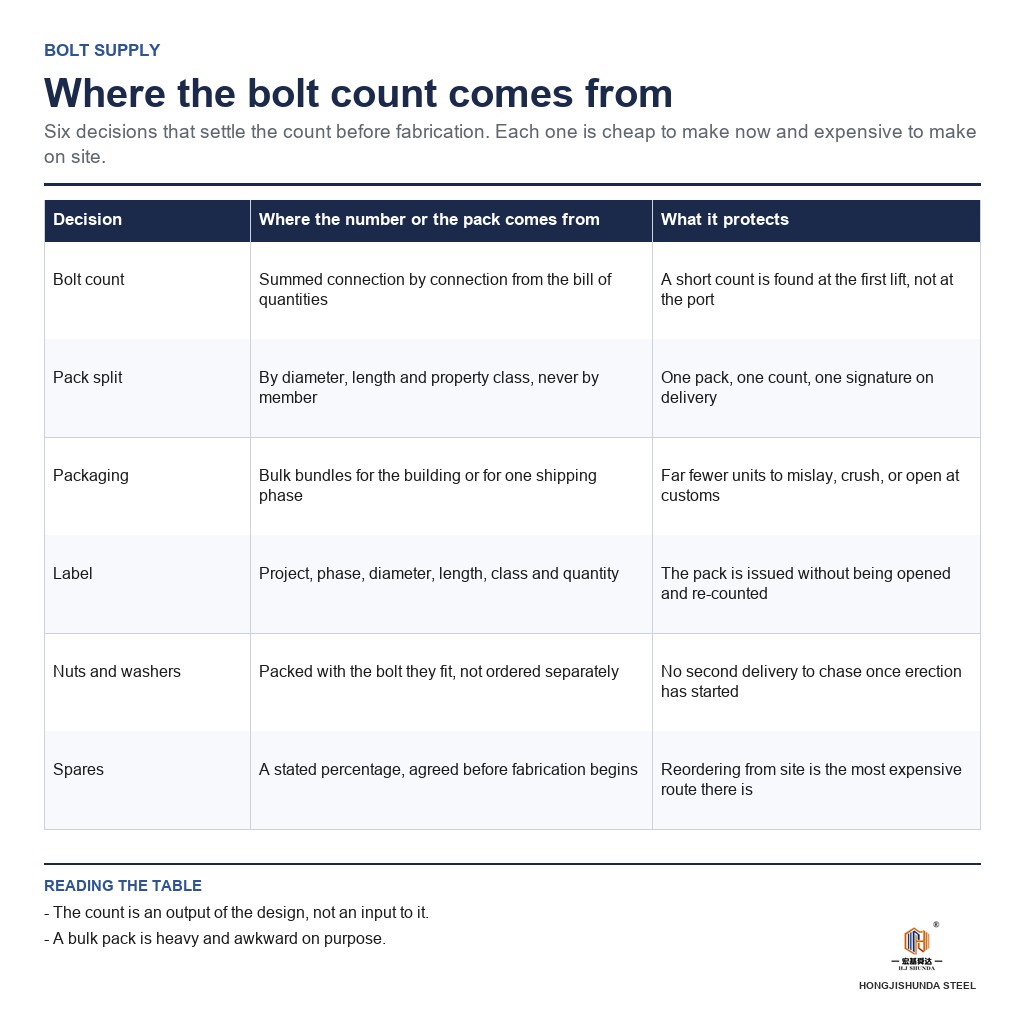
The number of bolts on a shipment is not a round figure chosen at packing time. It is a sum, and the sum has a source.
The bolt count starts from the bill of quantities
Every connection in the drawing set carries a bolt count. Multiply by the number of connections of that type, add the connections of every other type, and the total is the requirement for the building. That is the figure the bolts are bought and packed against.
Because it is derived, it moves whenever the drawing set moves. A revision that adds bracing, or changes a moment connection to a pinned one, changes the count. This is one reason the count is fixed late, close to fabrication, rather than at the enquiry stage.
Why the quantity is quoted with the building, not as a separate line
Bolts are a derived quantity of the building, so they are quoted with the building. Splitting them into a separate commercial line creates a second delivery event, a second set of documents, and a second chance for the two to arrive on different ships.
On site, that second delivery is the expensive one. A crew that has the steel and not the bolts has a crane, a gang, and no work. Keeping the bolts inside the building's scope keeps them inside the building's shipment.
What travels with the bolts
A bolt on its own does not make a connection. What travels matters as much as how much travels.
Nuts and washers are part of the same package
Nuts and washers are packed with the bolts they match. The count of washers is normally two per bolt, one under the head and one under the nut, and the count of nuts is one per bolt. When these are packed separately, the three components can arrive in three different places, and the connection stalls on the one that is missing.
Packing them together also protects the property class. A nut of the wrong class on a high-strength bolt is not a small error; it is a connection that will not reach its intended tension, and it will not announce itself until someone puts a wrench on it.
What is written on the pack, and why it matters
Each pack carries a label: diameter, length, property class, quantity, and the building or phase it belongs to. That label is the only identification the site needs. It lets a storeman confirm in one glance that the right pack has arrived, and it lets him refuse the wrong one before it is opened.
The label also survives what the contents cannot. Bolts are durable; packaging is not. A label wired to the outside of a pack can be read after a sea voyage. A label printed on a bag that has been under a container door for three weeks usually cannot.
What happens at the port of discharge
The first hour after discharge is where a bolt shipment is won or lost, and almost nothing that happens in that hour is technical.
The first check is the count, not the torque
Before anyone talks about tensioning, the pack is counted against the packing list. Not the whole pack bolt by bolt, but the pack count and the label check: the right number of packs, the right diameters, the right quantities on the labels. This takes minutes and catches the only failure that matters at that stage, which is a pack that did not arrive.
Torque and tension come later, on site, at the connection, with the equipment that does that work. Counting at the quay is a logistics act, not an engineering one, and it belongs to whoever signs for the cargo.
Storage: keeping the pack dry until erection starts
A bulk pack is easier to store than four hundred bags, and harder to store badly without noticing. It should sit off the ground, under cover, and stay sealed until the connection work begins. Bolts that sit in a puddle for a month are not the same bolts, whatever the certificate says.
The practical rule is that the pack is opened once, when it is needed, and resealed when the day's work stops. A pack left open at the laydown area becomes a pile of loose bolts within a week, and a pile of loose bolts is exactly the per-member kit problem in reverse.
Why bulk packing suits the erection sequence
Erection does not consume steel the way the drawing set is organised. It consumes it the way the crane can reach it, which is a different order.
Bolts are consumed by the connection, not by the member
A gang raising a bay needs bolts for the connections it is making now, in the diameters those connections use. It does not need the bolts for the member it raised last week, and it does not know yet which member it will raise after lunch. Bulk packs match that reality: take what the connection needs, in the size the connection uses.
Per-member kits match the drawing set instead. They are organised by the thing that is already on site, not by the work that is being done, and the mismatch shows up as bags carried around and never opened.
What the erecting crew needs before the first lift
Before the first lift, the crew needs three things from the bolt supply: the pack is on site, the pack is open, and the sizes needed for the first connections are in it. If any of those is missing, the lift does not happen, and the crane stands.
That is the argument for shipping the bolts with the steel rather than after it. It is not about saving a freight cost; it is about not creating a moment where everything is ready except one pallet.
The risk of splitting into per-member kits
Kitting is not wrong in every context. It is wrong when the connections are numerous, the members are numerous, and the site is far from the fabricator.
Short counts and where they surface
A short count in a bulk pack surfaces at the pack, during the count, before erection. A short count in a per-member kit surfaces at the connection, during erection, with the crane waiting. The total error is the same; the moment of discovery is not.
The second one is expensive in a way the first is not, because it converts a packing error into idle plant. And it is discovered by the person least able to do anything about it, at the worst possible time of day.
Mixed grades in one bag
When bolts are bagged per member, bags of different property classes sit next to each other in the same crate, and the crate gets opened on a site where nobody is checking labels against a drawing. A wrong-class bolt in a connection is not visible. It is installed, torqued, and covered by the next member.
Bulk packing does not remove that risk, but it contains it. One pack, one class, one label. The person taking a bolt out of the pack knows what he is holding without reading anything.
Spares and reordering
Every shipment should carry a small allowance above the calculated requirement, and the allowance should be deliberate rather than accidental.
How much spare to carry
Spare quantity is a judgement, not a formula. It covers the bolts damaged in handling, the ones dropped into a pit, and the ones that go missing between the laydown area and the connection. The allowance is normally a small percentage of the requirement, decided per project, and it is cheapest when it is decided at packing rather than discovered on site.
The wrong way to create the allowance is to round the order up and forget it. A spare that nobody recorded is not a spare; it is a surplus that will be found during the final clean-up, too late to help.
What to record before the pack is opened
Before the pack is opened, record what arrived: pack count, label quantities, and the batch identification on the pack. That record is what makes a later shortfall provable. Without it, a missing quantity is an argument; with it, it is a fact.
The record costs a few minutes at the port and saves a conversation three weeks later, when the only person who remembers the count is the one being asked to explain it.
Documentation that should travel with the steel
Bolts generate paperwork out of proportion to their weight, and most of it is useful only if it arrives with the cargo.
Packing list and marking
The packing list should state, per pack, the diameter, length, property class, and quantity, and should tie each pack to a shipping phase. Marking on the pack should match the packing list exactly, character for character. A mismatch between the two is the most common documentation failure on a bolt shipment, and it is the one that causes the most delay at inspection.
Traceability of the bolt batch
The batch identification on the pack should connect back to the manufacturer's records for that batch. That is what allows a question about a specific connection to be answered months later, without opening every pack on site. Traceability is not a certificate on a wall; it is a number on a label that still means something after the voyage.
Quality control before the pack is closed
Everything above assumes the right bolts went into the pack. Two checks make that assumption reasonable.
Incoming batch check
Before packing, the batch is checked against what was ordered: diameter, length, property class, and quantity. This is the last point at which a wrong delivery from a supplier can be caught cheaply, and the only point at which it can be caught before it becomes a site problem in another country.
The check is done on arrival at the fabricator, not after the pack is sealed. Once a batch is inside a sealed pack and on a ship, the only way to examine it is to open it, which defeats the purpose of sealing it. Catching a wrong batch at the goods-in door costs a phone call; catching it at the connection costs a crane hour and a decision about who pays for it.
Packing and sealing
The pack is then closed, labelled, and sealed in a way that shows whether it has been opened. A sealed pack that arrives open is information: someone has been in it, and the count should be treated as unverified until it is checked. Our quality management system is ISO 9001 certified, and packing and labelling fall inside it.
What we need from you to count the bolts
The bolt quantity cannot be quoted before the connections are known, and the connections are known only when the drawing set is settled. What helps at the enquiry stage is a short list, not a complete design.
What to send at first enquiry
Send the building type, the approximate span and length, the eave height, the crane duty if there is one, and the number of buildings. That is enough to size the structure and to say what the bolt supply will look like. Complete engineering drawings are not required for a first conversation.
Approximate figures are acceptable at this stage. A span given as thirty metres rather than an exact dimension changes the structural depth but not the connection logic, and it lets the conversation start weeks earlier than a fixed drawing set would allow. Exact numbers can replace the estimates once the design is frozen.
What can wait
Bolt diameters, lengths, property classes, and the final count can all wait until the drawing set is fixed. They are outputs of the design, not inputs to it, and asking for them too early produces a number that will be revised twice before it is used.
Before you ask for a bolt count
If you are preparing an enquiry and want the bolt supply treated as part of the building rather than as a separate purchase, gather these nine items first. Each one changes the count, the packing, or the delivery plan.
- Building type and intended use, so the connection types can be anticipated.
- Span, length, and eave height for each building, in metres and in feet.
- Column spacing, since it drives the number of frames and the connections per frame.
- Crane capacity and duty, if the building carries one, because crane beams add connections.
- Mezzanine or floor areas, which add beams and therefore connections.
- Whether the site is coastal or inland, so the corrosion system can be selected per project.
- The port of discharge and the inland destination, so the delivery boundary is agreed in writing.
- Who erects the steel, your own crew or a local contractor, so the packing suits their sequence.
- Whether you want the bolts inside the building's scope or on a separate order, decided once and recorded.
Send those nine and the bolt supply stops being a guess. Leave them out and the count will be revised on site, which is the most expensive place to revise anything.
Where to read next
Send the site conditions and we will answer with the numbers that matter