MOQ and a First Order from a Smaller Buyer
Small buyers ask the same question in almost the same words: what is the smallest building you will make. It is a fair question and it usually receives a fair answer that neither side finds satisfying, because the number sounds arbitrary and the reason behind it is never explained. The reason is not arbitrary at all. It is arithmetic, and once a buyer sees the arithmetic they can plan around it instead of negotiating against it.
Our own minimum on a standard package is 1,000 m². The rest of this note is why that number exists, and what a buyer with a smaller requirement can do that is better than trying to remove it.
What a steel structure MOQ actually is
A steel building is not manufactured in the sense a component is manufactured. It is engineered once, then cut and drilled to a specific set of drawings, then marked so that the parts can find their positions on a site the factory will never see. The engineering and the marking are per-building work, not per-tonne work, which is the whole reason a minimum exists.
There is no such thing as one building off the shelf
Nothing about a steel frame is interchangeable between projects once the drawings are issued. The span, the bay spacing, the wind load and the openings all change the member sizes, and the member sizes change the connections, and the connections change the hole positions. A frame made for someone else's building cannot be adjusted into yours without going back through the same engineering. This is why the factory cannot absorb a small order the way a component factory absorbs a short production run.
The floor comes from the container, not from the yard
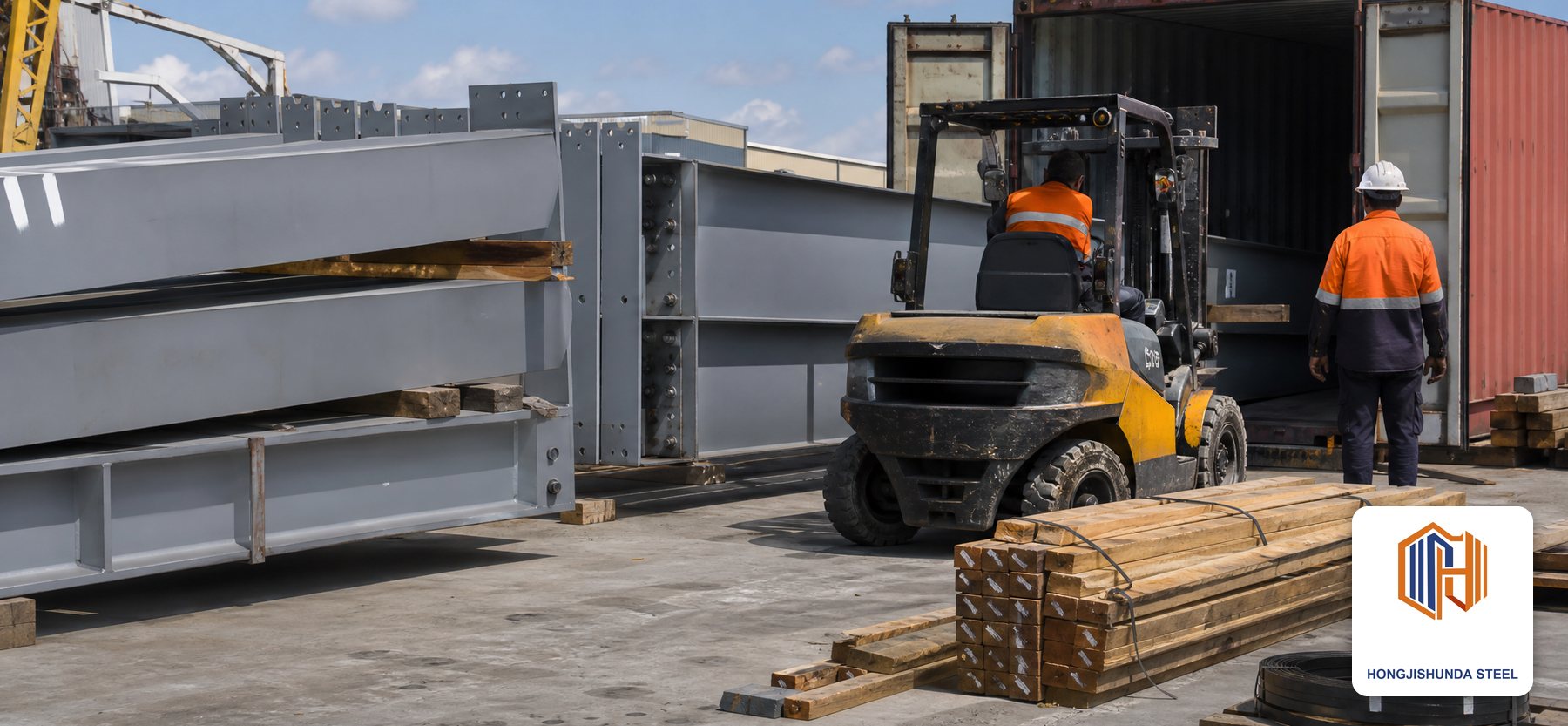
The practical floor on a shipped building is set by the transport envelope before the factory is even consulted. A container holds a certain volume and a certain weight, and a steel building is bulky relative to its weight because most of its volume is air between members. One container therefore represents a minimum sensible shipment, and a building well below that size still occupies a shipment, still requires a loading plan, and still consumes a production slot. The minimum is a shipping fact long before it is a commercial one.
Why the floor exists
Understanding what the fixed work consists of makes the number predictable, and predictability is what a smaller buyer actually needs. The fixed work divides into the work that happens before production and the work that happens at the loading door, and both are largely independent of how much steel the building contains.
Drawings, setting up and the production slot
Every building receives its own drawing set, its own setting out, its own cutting and drilling programme and its own place in the production sequence. A small building does not need fewer drawings than a large one; it needs the same drawings with shorter members. The setting up costs what it costs. This is the part of the minimum that surprises buyers most, because from outside it looks like the drawing effort should scale with size, and it does not.
One container is a building, not a parcel
Loading is a planning activity with a fixed cost per shipment. Bundles have to be planned so they can be lifted and so they unload in erection order, the container has to be packed so nothing bears on a connection, and the packing list has to match the loading sequence. Those activities happen for a small building exactly as they happen for a large one. A second container does not double the planning work, which is why a slightly larger order is often proportionally better value than a slightly smaller one.
Ways a small first order works
There are two legitimate approaches and they are frequently confused with each other. One adjusts the building to fit the minimum. The other adjusts the scope to fit the minimum. Only the first keeps the structure intact, and only the first is worth doing.
Standard sizes and stock sections
Standardising the geometry removes engineering work without removing capability. Using bay spacings and spans that fall on common section sizes reduces the design and the cutting effort, and it reduces the risk of a special section holding up the whole order. A building that is ordinary in its dimensions and specific only in its purpose is the cheapest kind of building to make, and for a first order that is exactly the right target.
A smaller scope rather than a cheaper building
The second approach is to keep the building as designed and move some of it outside the first order: supply the frame first and the envelope later, or supply one bay of a longer building as a first phase. This keeps the structure honest while reducing the steel in the first shipment. What must not happen is removing steel from the frame itself, because a frame with lighter members is not a smaller version of the same building, it is a different and weaker building.
What not to trade away
When a first order is squeezed, two things get squeezed first because neither is visible in the finished product. Both are invisible for exactly the same reason: they only show up later, on site, when the consequences have already happened.
Do not shrink the design wind speed
The design wind speed has to come from the site, stated in km/h with the source, and it cannot be reduced to save steel. A frame sized for a milder location is lighter, and it looks identical on a drawing, and it becomes a problem on the first day of bad weather. If a small order is being made to fit a budget, the place to take out steel is the envelope or the scope, never the wind load.
Do not shrink the marking and the packing list
Marking and the packing list are the first two items cut when a small order is treated as a simple one, and they are the two items that decide whether a small building can be erected by a small crew. A mark ties a member to a position. The packing list ties a bundle to a sequence. Without them, a crew of six spends a week working out what the factory already knew, and the saving made at the factory is spent twice over on site.
How to ask
The quality of the answer depends almost entirely on the first message. A first message that states a size and a purpose receives a minimum and a drawing request. A first message that states a size, a purpose, a location and a constraint receives a route, and a route is what a smaller buyer needs.
What to put in the first message
State the country and the site, the use of the building, the width and length you have in mind, the eave height if you know it, the design wind speed in km/h with its source if you have it, and the constraint that is actually binding your decision. That last item is the one most buyers leave out and the one that changes the answer, because a minimum that looks immovable becomes negotiable in structure once the supplier knows it is a first order rather than a full programme.
What a supplier can answer in one reply
A supplier who has those six facts can answer in one reply with a route rather than a refusal: what fits the minimum, what could phase, what would have to change, and what the standard package on offer actually contains. If the reply instead asks for a drawing before answering anything, that is a supplier quoting a process rather than a building, and the next reply will ask for another drawing.
Written by Johnny, who ships steel buildings to buyers in Africa and South America, including first orders from buyers who had never imported steel before. If you have a size smaller than the minimum and a real project behind it, send me the six facts and I will tell you what route exists.
Related: how to write a building brief · modular or stick built · what a 40 foot open top can carry · what drives the cost