Markets, and What Changes by Country
Every market page on this site is organised around the same question: what does a buyer in this country have to decide differently from a buyer anywhere else. The answers are not marketing. They are the four inputs that change the frame, the envelope and the delivery plan, and they can each be established before a drawing exists.
Below is the general logic, then the country pages. If your country is not listed, the four inputs still apply, and the fastest route is to send them to me directly.
The four inputs that change by country
Two of them are structural, one is a materials question, and one is logistics. All four are cheap to establish at enquiry and expensive to discover later.
Wind, and why a national map is not optional
Wind load is the largest single driver of frame weight in most of the markets we serve. It is also the input most often replaced by an assumption, because a buyer rarely has the wind speed to hand and the supplier rarely asks. The number has to come from the site, expressed in km/h, with a stated source. A coastal site, a cyclone-affected site and an inland plateau site at the same span are three different buildings.
Ground motion, where it applies
In seismic regions the frame is sized by drift rather than by gravity, and the connection details change with it. A portal frame that is a conservative choice in a low-seismic market is not conservative in a high-seismic one. This is the input where an imported design is most likely to be wrong, and where the difference cannot be seen in a finished building.
Corrosion and temperature
The third input is the air. It decides the coating system, and the coating system is the part of a steel building that determines whether it still looks like an asset in year ten.
Four environments, four coating systems
Coastal salt spray, inland humidity, industrial and chemical atmosphere, and dry desert. Each attacks steel in a different way and at a different rate, and a single specification applied across a site with more than one of them will be wrong in both directions. The specification should be a dry film thickness in microns, named per zone, not a product name.
Heat, and what it does to a roof
In hot climates the roof is a thermal element before it is a structural one. Surface colour, insulation and ventilation openings decide the internal temperature, and the internal temperature decides whether the building is usable at two in the afternoon. This is a design decision, not a finishing choice, and it is cheapest to make at enquiry. Ask for the surface finish and the ventilation opening area as numbers, because a build-up described by product name cannot be compared between suppliers. Ask for the surface finish and the ventilation opening area as numbers, because a build-up described by product name cannot be compared between suppliers. Ask for the surface finish and the ventilation opening area as numbers, because a build-up described by product name cannot be compared between suppliers. Ask for the surface finish and the ventilation opening area as numbers, because a build-up described by product name cannot be compared between suppliers.
The route from the port to the site
The fourth input is the one that surprises buyers, because it is not an engineering input at all and yet it constrains the design. A member that cannot reach the site cannot be built, however well it is designed.
Axle limits, bridges and the last hundred kilometres
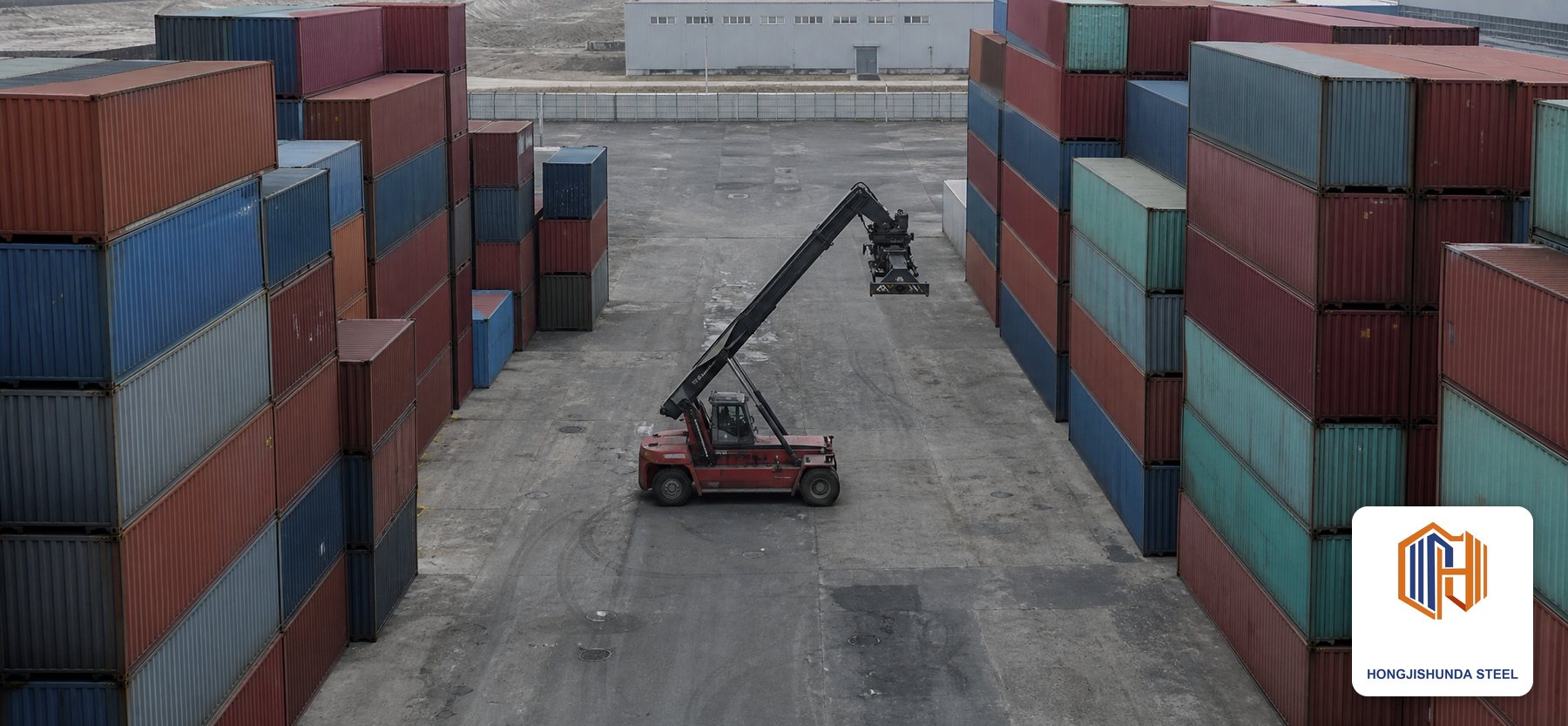
The transport envelope is set by the smallest constraint on the route, not by the largest vehicle available. Weight per axle, bridge clearances, road width and the condition of the final approach all decide the maximum member length and mass. A design that is optimal for fabrication can be undeliverable, and the fix is a splice that should have been drawn at the start.
Landlocked markets, and the transit document
Where the site is inland and the port is in another country, the shipment moves under a transit regime that has its own paperwork, its own bond and its own delays. The container is not cleared once; it is cleared at the port and again at the border. Buyers who plan for one clearance plan for half the time they need.
The country pages
Six markets are written up below. Each page states what changes, what it changes about the building, and what to settle before asking for a price. Two of them carry delivered references from our own register; the others describe the market without claiming work we have not done.
Brazil
Two delivered buildings, a long humid coast, and an import process that is decided at state level as much as at federal level. Steel buildings for Brazil covers wind, corrosion zones, Portuguese documentation and what the state tax step actually costs a first importer. The wind figure and the destination state are the two items that change the answer most, and both are known before a drawing exists. The wind figure and the destination state are the two items that change the answer most, and both are known before a drawing exists. The wind figure and the destination state are the two items that change the answer most, and both are known before a drawing exists. The wind figure and the destination state are the two items that change the answer most, and both are known before a drawing exists.
Burkina Faso
Three delivered buildings, a landlocked route with a choice of three ports, and a climate that alternates between dust-laden wind and standing water. Steel buildings for Burkina Faso covers the transit bond, axle limits on the Ouagadougou corridor, and why the rainy season decides the erection programme rather than the fabrication schedule. The corridor decides the maximum member length, and the rainy season decides when that member can be lifted into place. The corridor decides the maximum member length, and the rainy season decides when that member can be lifted into place. The corridor decides the maximum member length, and the rainy season decides when that member can be lifted into place. The corridor decides the maximum member length, and the rainy season decides when that member can be lifted into place.
Chile
Seismic design is the dominant input, and it is not a margin added to a portal frame. Steel buildings for Chile covers drift, connection behaviour, the coastal corrosion gradient and the transport consequence of a country four thousand kilometres long. Ask for the drift limit and the connection basis in writing, because neither is visible in a delivered building and neither can be inferred from the sections. Ask for the drift limit and the connection basis in writing, because neither is visible in a delivered building and neither can be inferred from the sections. Ask for the drift limit and the connection basis in writing, because neither is visible in a delivered building and neither can be inferred from the sections. Ask for the drift limit and the connection basis in writing, because neither is visible in a delivered building and neither can be inferred from the sections.
Peru
Seismic design on a desert coast with almost no rain and a great deal of salt fog, then mine sites at altitude where the air is thin and the corrosion is different again. Steel buildings for Peru covers those three environments and the Amazon fourth. The same span is three different buildings on the coast, in the sierra and in the Amazon, and the specification follows the site rather than the country. The same span is three different buildings on the coast, in the sierra and in the Amazon, and the specification follows the site rather than the country. The same span is three different buildings on the coast, in the sierra and in the Amazon, and the specification follows the site rather than the country. The same span is three different buildings on the coast, in the sierra and in the Amazon, and the specification follows the site rather than the country.
Ghana
A humid coastal market with a single main port and a construction season set by two rainy periods. Steel buildings for Ghana covers corrosion rates near the coast, the Tema route, and why the roof is specified before the frame. The roof detail and the dry window are the two decisions that determine whether the programme holds at all, and both are settled before the frame is ordered. The roof detail and the dry window are the two decisions that determine whether the programme holds at all, and both are settled before the frame is ordered. The roof detail and the dry window are the two decisions that determine whether the programme holds at all, and both are settled before the frame is ordered. The roof detail and the dry window are the two decisions that determine whether the programme holds at all, and both are settled before the frame is ordered.
Zimbabwe
A landlocked highveld market where the climate is mild and the constraints are commercial and logistical rather than environmental. Steel buildings for Zimbabwe covers the mild-climate advantage, the import permit sequence and the transport envelope from Beira and Durban. The mild climate removes the usual failure modes, which leaves the specification and the import sequence carrying the whole risk on their own. The mild climate removes the usual failure modes, which leaves the specification and the import sequence carrying the whole risk on their own. The mild climate removes the usual failure modes, which leaves the specification and the import sequence carrying the whole risk on their own. The mild climate removes the usual failure modes, which leaves the specification and the import sequence carrying the whole risk on their own.
If your country is not listed
The four inputs are the same everywhere. Send the site location, the intended use, the span you need and the port you would ship to, and the country page becomes a set of answers rather than a request. The nine-input list is the shortest version of what is needed. A country page is a shortcut rather than a requirement, and the four inputs are the same wherever the site happens to be. A country page is a shortcut rather than a requirement, and the four inputs are the same wherever the site happens to be. A country page is a shortcut rather than a requirement, and the four inputs are the same wherever the site happens to be. A country page is a shortcut rather than a requirement, and the four inputs are the same wherever the site happens to be.
Written by Johnny, who ships into these markets and has learned the four inputs the hard way. If your country is not on the list, send me the site location and the port and I will tell you what changes.
Related: what to send before asking for a price · who clears customs · wind zones and the design · coastal salt spray · delivered projects