Steel Buildings for Peru
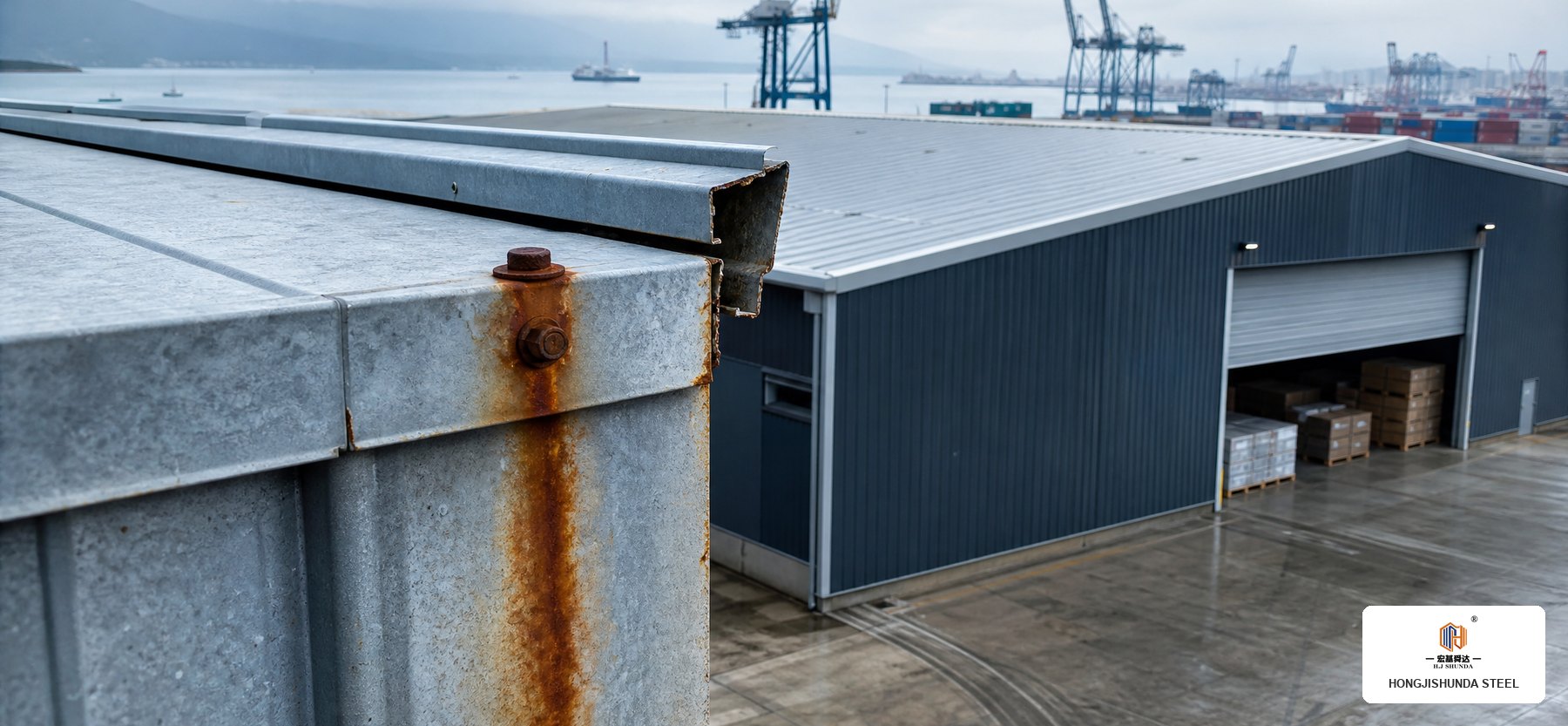
Peru is the clearest case in our markets of a country where the climate map matters more than the border. We have not yet delivered a project here and this page does not claim one. What it does is set out the four environments, because they are the reason a Peruvian enquiry cannot be answered with a single quotation.
The order below follows the population of enquiries we receive: coastal industrial and mining support first, then the sierra, then the Amazon.
The coastal desert: corrosion without rain
The Peruvian coast is one of the driest places on earth at sea level, and that is exactly what makes it aggressive. Salt fog lands on the steel and stays there, because there is no rain to wash it off. The mechanism is different from a wet coast and it produces a different failure pattern.
Why no rain is worse than rain
On a coast with regular rain, salt deposits are periodically removed. On a coast without it, the deposit accumulates and becomes concentrated, and the corrosion rate rises as the concentration rises. The first places to fail are the fixings, then the cut edges, then the lapped joints where moisture is trapped. All three are the parts a construction photograph never shows.
What the specification has to say
Ask for a dry film thickness in microns, per zone, with the fasteners specified at the same level as the sheeting. A common failure is a well-coated sheet fixed with under-coated screws, which produces a galvanic pair at every fixing point and a roof that fails at the fixings long before the sheet does. Fastener coating is part of the system, not an accessory.
The sierra: seismic, high and cold
Above roughly two thousand metres the design changes twice: the ground motion governs the frame, and the altitude changes the thermal and UV environment of the envelope.
Ground motion is the controlling case
As in Chile, the frame is sized by drift and the connections are what carry the load. A gravity-and-wind frame looks identical once clad, which is why the design basis has to be stated in writing rather than inferred from the sections. Ask which basis was used and against what drift limit. Ask for the drift limit and the connection basis as written values, because a frame designed for gravity and wind looks identical once the cladding is on. Ask for the drift limit and the connection basis as written values, because a frame designed for gravity and wind looks identical once the cladding is on.
Altitude changes the envelope, not the frame
Thin air transfers heat differently, so a roof that performs in Lima performs differently at four thousand metres. UV exposure is higher, which ages sealants and painted finishes faster. Neither is a structural issue and both belong in the specification. State the site elevation with the location. State the elevation with the location, and ask for the sealant and finish to be named, because both age faster under the stronger UV at height. State the elevation with the location, and ask for the sealant and finish to be named, because both age faster under the stronger UV at height.
The Amazon: humidity, biology and transport
The eastern side of the country is a different problem again: high humidity, high temperature, intense rainfall and biological growth on any surface that stays damp.
Condensation as the primary mechanism
In a hot humid climate a single-skin roof condenses on its underside for much of the year, and the water drips onto whatever is below. It reads as a leak and it is not one. The remedy is an envelope decision, made before the roof build-up is priced. Our note on why a steel warehouse rains indoors covers the mechanism.
Getting there at all
Transport to the interior is the constraint that changes the design, because the route from the port is long and partly unpaved. Members must be sized for the road, which usually means splices drawn from the beginning. Name the port and describe the final stretch, including whether the site can take a 40-foot trailer. Ask for the maximum member length the route allows before the drawings are approved, so that splices are designed rather than improvised on arrival. Ask for the maximum member length the route allows before the drawings are approved, so that splices are designed rather than improvised on arrival.
What to settle before asking for a price
Peru needs one item that the other market pages do not, because the answer changes the whole specification.
Which of the four Perus the site is in
Coast, sierra, Amazon, or a transitional zone. Give the location and the elevation and the answer follows. A single specification sent to a coastal site and a sierra site will be wrong at both, in opposite directions, and the error is not visible until the building has been up for a few years. Give the location and the elevation and the classification follows, which is faster and more reliable than describing the climate in words. Give the location and the elevation and the classification follows, which is faster and more reliable than describing the climate in words.
The seismic basis, stated
Give the location and the intended use, and ask any supplier to state the basis they used. An unstated basis cannot be reviewed, and a review is the only thing that catches an imported frame designed for a different load case. The general logic is on when no local code applies. Ask any supplier to name the basis they used, because an unstated basis cannot be reviewed and a review is the only thing that catches an imported frame. Ask any supplier to name the basis they used, because an unstated basis cannot be reviewed and a review is the only thing that catches an imported frame.
The transport envelope, in numbers
Maximum member length, mass and width that the route allows. This single line saves a revision cycle and sometimes a redesign, and it is the item most often omitted from a first enquiry. Three figures are enough: the longest member the road allows, the heaviest, and the widest, since each one constrains a different part of the design and the tightest of the three sets the splice positions. Three figures are enough: the longest member the road allows, the heaviest, and the widest, since each one constrains a different part of the design and the tightest of the three sets the splice positions.
The intended use, and whether anything is stored under the roof
A mining workshop and a covered stockpile are different buildings at the same span, because the first has equipment loads and a crane and the second has dust and a floor that must drain. State the use, and state whether a crane is intended even if it is being bought later. Rail level cannot be raised afterwards. A covered stockpile needs a floor that drains and a frame that carries dust, while a workshop needs equipment loads and a rail, and the two are not the same building. A covered stockpile needs a floor that drains and a frame that carries dust, while a workshop needs equipment loads and a rail, and the two are not the same building.
Written by Johnny, who has not yet shipped into Peru and will tell you so, because a market page that claims work is worth less than one that describes the decisions. If you are preparing a Peruvian enquiry, send me the location, the elevation and the route limits.
Related: all markets · coastal salt spray · condensation in a humid climate · when no local code applies · delivered projects