Steel Buildings for Chile
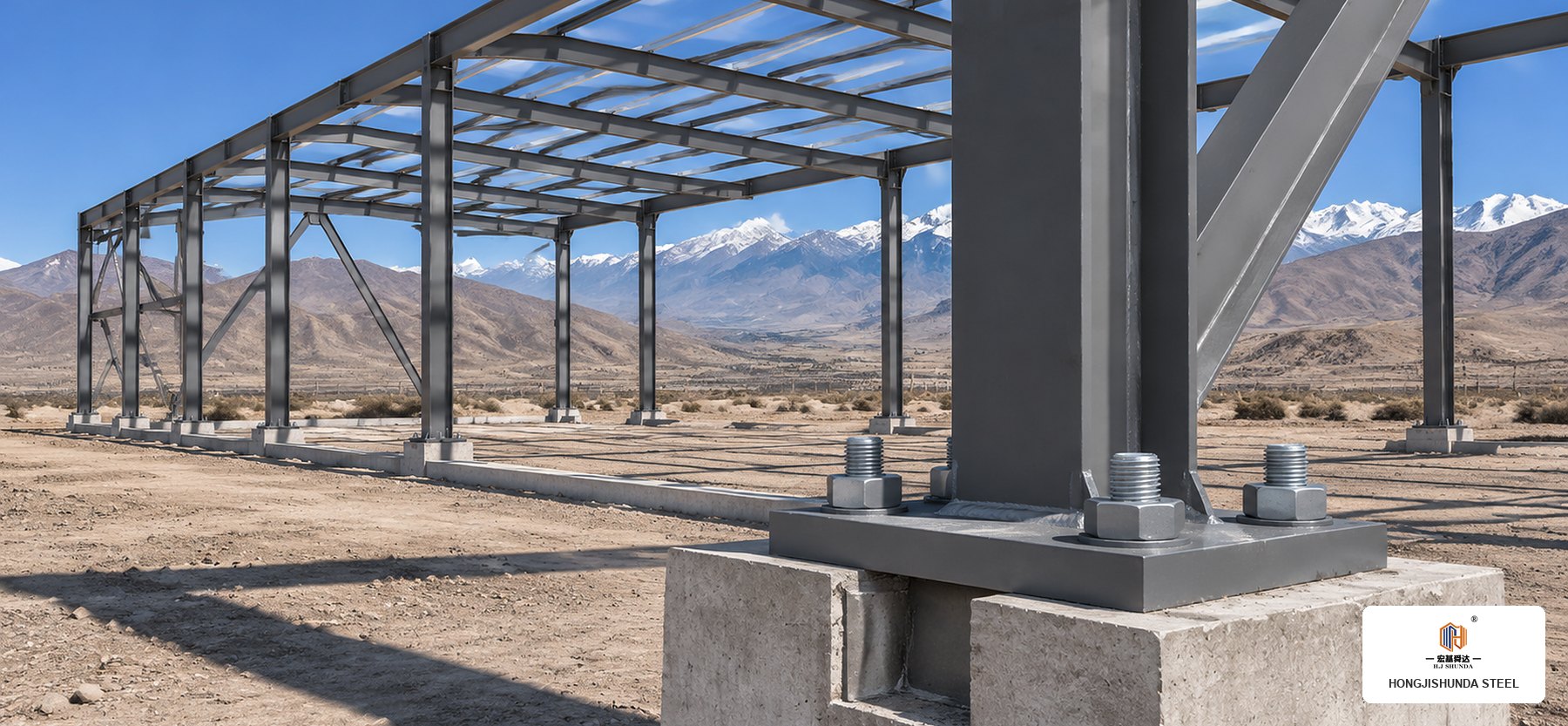
Chile is the market where an imported design is most likely to be wrong without anyone noticing. The reason is that a portal frame designed for gravity and wind looks identical to one designed for ground motion. The difference is in the bracing system, the connection details and the drift limit, and none of those are visible once the cladding is on.
This page covers the three inputs that decide a Chilean building, and the one consequence that catches first-time buyers: how long the country is.
Ground motion is the design case
Under earthquake loading a steel frame is not asked to stay undamaged; it is asked to deform in a controlled way and to keep standing. That is a different design philosophy from the one behind a wind-governed frame, and it produces different details even when the sections are similar.
Drift, and why it is the controlling number
Drift is how far the top of the frame moves sideways relative to the bottom. It is limited because excessive movement damages the cladding, the connections and anything attached to the frame. In a wind-governed building drift is rarely critical. In a seismic one it often governs, and it governs the bracing rather than the rafter. Ask whether the design was checked for drift and against what limit.
Why the connection is the part that matters
A connection designed only for gravity and wind can be detailed in a way that has almost no capacity to rotate. Under seismic loading that detail concentrates stress at the weld and fails there. The remedy is a connection designed for the movement, and it has to be decided at the drawing stage because it changes the fabrication. Ask for the connection detail and ask what load case it was designed for.
The coast, and the interior, are two specifications
Chile is narrow and its climate is not uniform along its length, so a single coating specification across a project is likely to be wrong at one end. The corrosive environment is coastal and it is driven by onshore wind, which means the effect reaches further inland in some regions than in others.
Corrosion is a distance and a direction
Ask for the coating to be specified by zone: the members exposed to onshore air, the members sheltered by the building itself, and the roof underside where condensation collects. The specification should be a dry film thickness in microns rather than a product name, so that it can be checked against the delivered steel. Our note on coastal salt spray sets out what eighteen months does.
The dry north is not the humid south
In the north, the problem is salt fog with almost no rain to wash it off, which concentrates the deposit. In the south, the problem is rain and humidity, which drives condensation and attacks the cut edges and the fixings. Two different failure modes on the same drawing set, and the envelope detail differs between them. Specify the two zones separately even on one project, since a single system applied across both will be over-specified in one and inadequate in the other. Specify the two zones separately even on one project, since a single system applied across both will be over-specified in one and inadequate in the other. Specify the two zones separately even on one project, since a single system applied across both will be over-specified in one and inadequate in the other. Specify the two zones separately even on one project, since a single system applied across both will be over-specified in one and inadequate in the other.
Four thousand kilometres of transport
The distance from a port to a site is a design input in Chile more than in most markets, because the interior is far from the coast and the road south is long. A member that is optimal for fabrication can be undeliverable, and the fix is a splice that has to be on the drawing.
What to state about the route
Name the port and the site, and describe the last stretch: road width, any bridge weight limit, and whether the site can accept a 40-foot trailer. The maximum member length follows from the smallest constraint on that route, not from the largest truck available. Ask for the design to be checked against the transport envelope before the drawings are approved.
Altitude, if the site is in the mountains
At altitude the air is thinner, which changes heat transfer and therefore the internal temperature, and the UV exposure is higher, which ages sealants and coatings faster. Neither is a structural issue and both change the specification. State the site elevation with the location. State the elevation in metres with the location, because the roof build-up and the sealant choice both follow from it rather than from the latitude. State the elevation in metres with the location, because the roof build-up and the sealant choice both follow from it rather than from the latitude. State the elevation in metres with the location, because the roof build-up and the sealant choice both follow from it rather than from the latitude. State the elevation in metres with the location, because the roof build-up and the sealant choice both follow from it rather than from the latitude.
What to settle before asking for a price
Four items, and the first two are the ones that separate a Chilean quotation from a generic one.
The seismic parameters, from the site
Give the location and the intended use. The seismic demand follows from the site and the occupancy, and it must come from the local basis rather than from an assumption carried over from another country. Ask any supplier to state which basis they used, in writing, because an unstated basis cannot be reviewed. Give the location and the intended use together, since the demand follows from both and an occupancy stated later changes the design limit. Give the location and the intended use together, since the demand follows from both and an occupancy stated later changes the design limit. Give the location and the intended use together, since the demand follows from both and an occupancy stated later changes the design limit. Give the location and the intended use together, since the demand follows from both and an occupancy stated later changes the design limit.
Distance from the sea, and the prevailing wind direction
Both, not just the distance. A site twenty kilometres inland with onshore wind can be more aggressive than a sheltered site five kilometres from the water. With those two facts the coating system can be specified per zone rather than guessed. With those two facts the coating can be specified per zone instead of guessed, and the guess is what shows up as corrosion at the fixings in year three. With those two facts the coating can be specified per zone instead of guessed, and the guess is what shows up as corrosion at the fixings in year three. With those two facts the coating can be specified per zone instead of guessed, and the guess is what shows up as corrosion at the fixings in year three. With those two facts the coating can be specified per zone instead of guessed, and the guess is what shows up as corrosion at the fixings in year three.
The transport envelope, in numbers
Maximum length, maximum mass and maximum width that the route allows. Given those three, the splice positions can be drawn rather than discovered. This is the single most useful line in a Chilean enquiry and it is almost never included. Maximum length, mass and width on the worst section of the route, because the worst section is what the splice positions have to satisfy. Maximum length, mass and width on the worst section of the route, because the worst section is what the splice positions have to satisfy. Maximum length, mass and width on the worst section of the route, because the worst section is what the splice positions have to satisfy. Maximum length, mass and width on the worst section of the route, because the worst section is what the splice positions have to satisfy.
The intended use, because it changes the drift limit
A warehouse tolerates more movement than a building with a crane or with precision equipment inside. The intended use therefore changes the design limit, and stating it saves a revision. The nine-input list on what to send before asking for a price covers the rest. Say also whether a crane is intended even if it is being bought later, because rail level cannot be raised once the columns are standing. Say also whether a crane is intended even if it is being bought later, because rail level cannot be raised once the columns are standing. Say also whether a crane is intended even if it is being bought later, because rail level cannot be raised once the columns are standing. Say also whether a crane is intended even if it is being bought later, because rail level cannot be raised once the columns are standing.
Written by Johnny, who does not design to Chilean seismic requirements without the site parameters and will say so. If you are preparing a Chilean enquiry, send me the location, the distance from the sea and the route limits and I will tell you which input governs.
Related: all markets · where a portal frame fails in Chile · coastal salt spray · when no local code applies · delivered projects