Who Does What Between Factory and Site
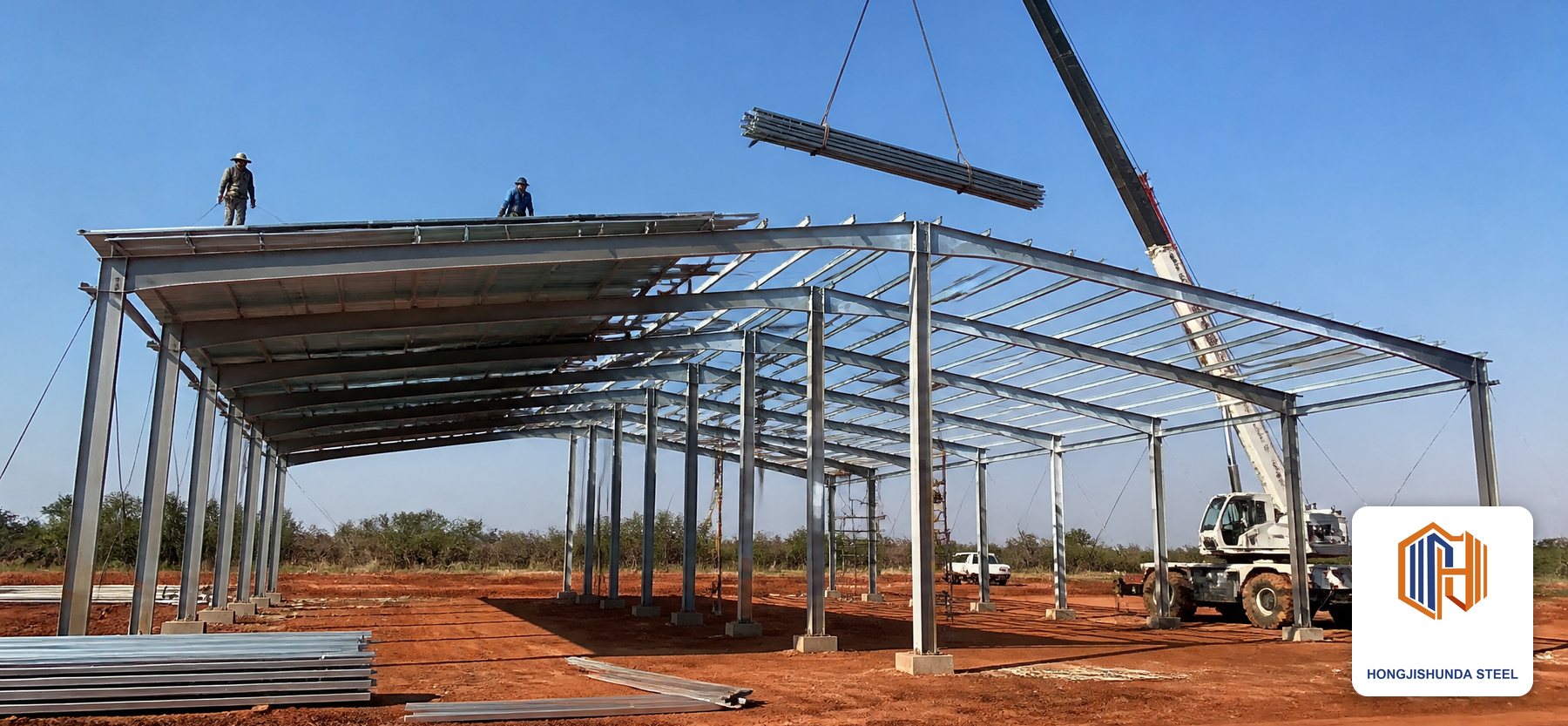
A factory quotation and a site programme describe two adjacent worlds, and the seam between them is where steel building projects lose the most money. Not because anybody is careless, but because the seam sits outside both parties' normal scope. The fabricator's job ends at the gate. The erector's job begins when the steel is on the ground. Everything in between is nobody's core business, and so it becomes whoever is standing closest.
This note is a map of that seam. It is written for a buyer who is about to place a first order and has not yet discovered which tasks are missing an owner.
Why the gap exists at all
The gap is structural. A fabricator is organised around production, and production ends when a member is packed. A contractor is organised around construction, and construction begins when material is available. Both organisations are correct and both are complete, and they do not overlap. The gap is the space between two complete systems, which is why it is invisible on both sides until something fails inside it.
Two correct scopes that do not touch
The fabricator's scope typically ends at delivery to a named place, and the contractor's scope typically begins at material on site. If the named place is the port, then the inland leg is in neither scope. If the named place is the site, then unloading may be in one and storage in neither. Neither party has made an error. The two documents simply describe a perimeter each, and the perimeters do not share an edge.
The tasks that look like someone else's
Every task in the gap has a plausible owner in the buyer's mind, which is precisely why it never gets written down. The buyer assumes the fabricator includes the bolts because bolts are steel. The fabricator assumes the buyer's contractor buys them locally because they are consumables. Both assumptions are reasonable, and the disagreement surfaces on the day the first column is ready to be fixed and there are no bolts on site.
The tasks that fall in it
The list is short and stable across projects. It does not change with the size of the building, which means it can be settled once, in advance, and reused for every order afterwards.
Packing, marking and the loading plan
Packing is the fabricator's work, but the loading plan is a joint document, because it encodes the erection sequence. Members must come out of the containers in the order they will be lifted. If the loading plan is written by whoever loads fastest, the erector spends the first week moving steel twice. Ask who produces the loading plan and whether the erector has seen it before the containers are sealed.
Unloading, and what happens to a damaged member
Unloading requires equipment the site may not own, and the decision to unload is a decision to accept the condition of the goods. Whoever signs for the container is holding the evidence. Ask who unloads, who inspects at unloading, and where a damaged member is stored while it is being resolved. A member left in the mud for a month while emails are exchanged is a member that will be replaced rather than repaired.
Bolts, grout, and the small items nobody quotes
High-strength bolts, nuts, washers, grout for the base plates, shims and touch-up paint are all small, all necessary, and all routinely omitted from both sides. They are also the items most likely to be unavailable locally at the required grade. Ask for them as a named line with a quantity derived from the drawing, and ask whether they ship with the frame or are bought on arrival.
Reading the quotation for who owns what
A quotation can be read as an allocation of responsibility rather than a list of prices. Read that way, it becomes obvious which tasks have been placed and which have been left floating, without needing to ask about any of them individually.
The delivery term is the fault line
The delivery term marks the exact point where the supplier's risk ends. Everything before that point is theirs, everything after it is the buyer's, and the tasks sitting immediately on the far side of the line are the ones most often forgotten. Read the term and then list the first three things that must happen after it. Those three are the buyer's, and they need a name.
The exclusions list is the buyer's to-do list
Most buyers read the exclusions list as bad news. It is better read as a work breakdown: each exclusion is a task that has to be bought from somebody. Convert every exclusion into a line with a named party and a date, and the site phase acquires a plan. An exclusion that stays an exclusion is a task waiting to become a surprise.
The handover at the port
The port is where the seam is widest, because it is the one place where goods change hands between parties who have no contract with each other. It is also the place where time costs money in a way that is easy to predict and easy to ignore.
Where the clock starts
Free time at a port is finite, and the clock starts when the container is discharged rather than when the buyer is ready. Ask what the free period is, at which terminal, and what the daily charge becomes afterwards. Then compare that to the realistic clearance time for a first import in that country. A first shipment that assumes the same clearance speed as a routine one is a shipment that budgets for charges it has not priced.
Who holds the documents, and when
The bill of lading, the packing list, the invoice and the certificate of origin travel separately from the steel. Ask who receives the originals, by which route, and how long that takes. A container can sit fully cleared but unreleasable for a week because one original document is in a courier's bag. Name the recipient and the courier before the vessel sails.
Writing the map before the order
The remedy is not a longer contract. It is a one-page table, produced before the order and attached to it, that lists each task in the seam against a named party. The table is short enough that nobody avoids reading it, which is the whole point.
One page, four columns
Four columns are enough: the task, the party responsible, the document that proves it happened, and the date. Anything that cannot be filled in for a task is a task that has no owner, and finding that out before the order is the entire value of the exercise. Keep the table in the same file as the scope so the two cannot drift apart.
Who signs it
The table should be signed by the buyer and the supplier, and acknowledged by the erector if one is already appointed. A signature is not a legal necessity; it is a way of making sure the table has been read by the person who will be held to it. An unsigned map is a good intention. A signed one is a plan.
Written by Johnny, who has watched this seam from the factory side and seen what arrives at the other end of it. If you are about to place a first order, ask me for the one-page map and I will fill in our side of it.
Related: packing list, container list and schedule · who clears customs · erection sequence as a design output · choosing a supplier